


If you feel like digital marketing is getting more challenging, you’re not alone. The majority of operators say getting more direct bookings is their top priority, but less than one in four rate their marketing as effective, according to Arival’s latest Global Operator Landscape study. The disconnect is stark: travel and tourism demand has hit record levels, yet most operators don’t feel their digital marketing strategies are working.
So how do you navigate the rapidly shifting landscape of digital marketing for travel in the era of AI, short-form video, and increased personalization? The rules have fundamentally changed. Artificial intelligence (AI) has moved from experiment to essential infrastructure. Social media platforms now drive full-funnel conversions, not just inspiration. The path to purchase has fractured across voice search, AI assistants, and traditional channels, making attribution harder than ever for the travel industry.
This guide walks you through the latest trends and five actionable priorities that can help you recapture direct bookings, improve customer experience, and build tourism marketing systems that actually perform. Each section includes clear next steps you can implement immediately.
Here’s what we’ll cover:
- Essential Foundation: Optimize for Google Things to Do
- Priority 1: Use AI to Personalize the Customer Journey
- Priority 2: Master Social Media Platforms as Full-Funnel Conversion Engines
- Priority 3: Use Data-Driven Marketing Strategies That Actually Drive Conversions
- Priority 4: Use Sustainability to Stand Out
- Priority 5: Automate Marketing Operations Without Losing the Human Touch
- Take Your Digital Marketing to the Next Level
Essential Foundation: Optimize for Google Things to Do
Before implementing any of these five priorities, ensure your tourism experiences are discoverable where travelers actively search. Google Things to Do has become a critical distribution channel for tour operators.
Being visible on Google Things to Do ensures your experiences appear prominently when travelers search for activities in your destination, and can lead them to direct online booking options that bypass online travel agency (OTA) commissions entirely.
Getting your inventory properly set up on Google Things to Do should be considered an essential first step, not an optional marketing tactic. Without this visibility, even the most sophisticated digital marketing strategies will struggle to capture demand from travelers actively searching for experiences exactly like yours. This is particularly important as voice search and AI assistants increasingly pull answers directly from Google’s structured data, making proper integration essential for future discoverability in the travel industry.
Start here: Google Things to Do Guide for Experience Businesses
Priority 1: Use AI to Personalize the Customer Journey
AI-powered personalization is no longer optional for effective digital marketing for tour operators. Travelers expect relevant recommendations before they even begin searching. Modern predictive systems can analyze browsing behavior, booking history, seasonal preferences, and external signals like weather forecasts or local events to anticipate customer intent and trigger personalized offers at exactly the right moment.
How AI-Powered Personalization Works
Think about it like this: when a user researches outdoor activities in mild climates, checks school holiday dates, and browses family-friendly accommodation within 48 hours, that’s not random browsing. That’s a specific intent signal for a spring family adventure.
Predictive systems recognize these patterns and trigger personalized digital marketing campaigns before the traveler even types a search query.
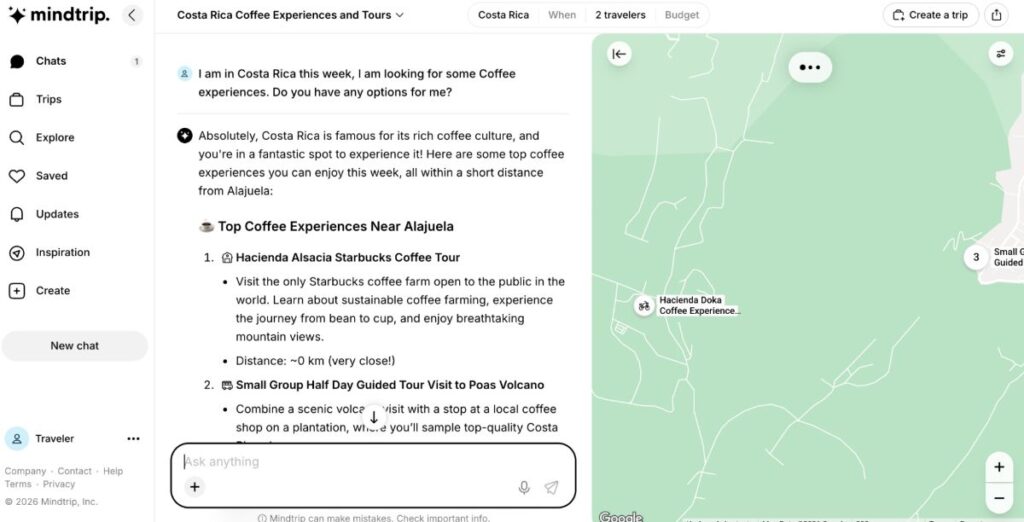
The business impact is measurable. Companies using predictive journey mapping and AI-powered personalization report up to 25-30% increases in booking conversions and significant drops in customer acquisition costs. Tools like Mindtrip are making this accessible for travelers, using artificial intelligence to automatically update itineraries as users make choices: adjusting flights, hotels, and activities dynamically without requiring manual updates.
Trip-Planning Tools for Operator Websites
AI-driven personalization extends beyond predictive journey mapping. Tour operators and OTAS are now embedding custom trip-planning widgets directly into their websites, allowing users to describe their ideal tourism experience in natural language and instantly receive curated itineraries.
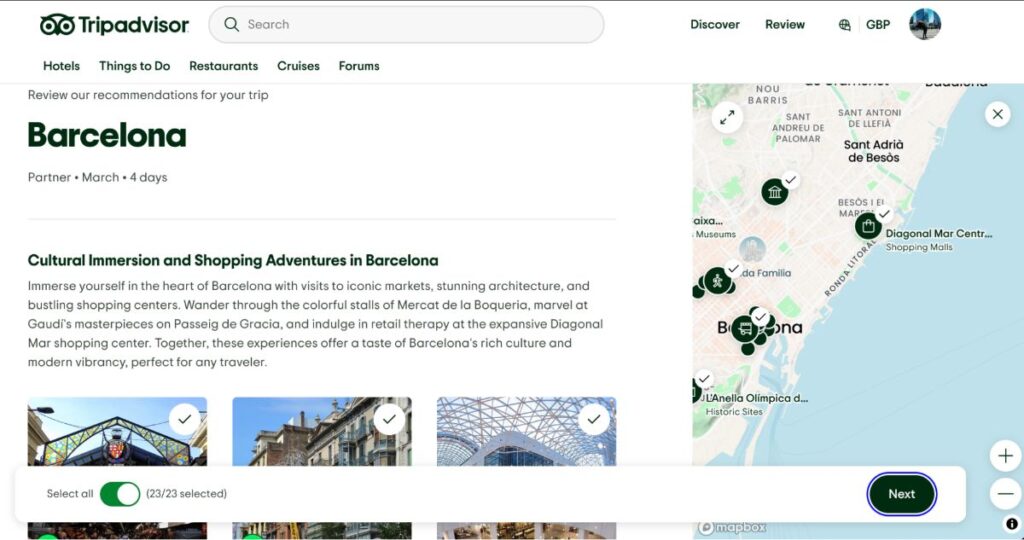
Voice agents powered by tools like ElevenLabs are entering the space, enabling hands-free trip discovery through conversational interfaces that feel natural and responsive.
These capabilities fundamentally change how travel brands interact with potential customers. Instead of static product pages and generic funnels, successful operators are moving toward adaptive, conversational, and intent-aware experiences that respond in real time to user behavior. The opportunity is enormous for operators who embrace AI early to deliver genuinely customized customer journeys at scale, increase conversion rates, and build stronger direct-booking relationships that don’t depend on OTA commissions.
What to Do Next
- Explore adding an AI-powered trip-planning widget to your website (such as the ChatGPT travel plugin by Elfsight) that lets users describe their ideal experience in natural language.
- Use your existing booking data alongside website analytics to identify patterns: when do certain customer segments book, and what triggers conversions?
- Implement personalization in your email marketing based on browsing behavior and past booking history, even basic segmentation outperforms generic broadcast messages.
13-15 April 2027 Insider Pro Access Members Save 20% THE event of the year for the European in-destination experiences industry Save up to €850 with an Autumn Advantage Ticket as an Insider Pro Member!
Priority 2: Master Social Media Platforms as Full-Funnel Conversion Engines
Travelers are no longer using social media platforms simply as inspiration boards. These platforms now drive actual bookings directly, functioning as complete tourism marketing ecosystems that influence every stage of the travel purchase funnel.
TikTok has seen a 410% increase in travel content views since 2021, with over 70% of European users indicating they book holidays based on TikTok recommendations. This isn’t passive consumption—travelers actively seek destination marketing, accommodation reviews, and experience validation through short-form video content.
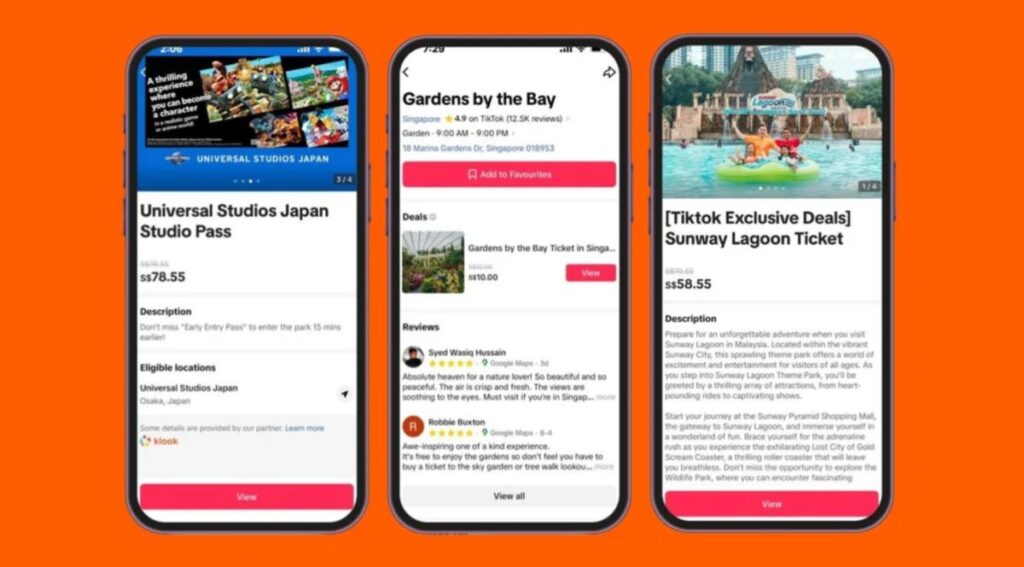
This shift toward social commerce is already being productized. Platforms like Klook now offer direct TikTok integrations that allow users to move from inspiration to online booking without ever leaving the app. That kind of native social commerce infrastructure signals where digital marketing for tourism is heading: fewer steps, less friction, and tighter alignment between content marketing and conversion.
Platform-Specific Content Strategies
TikTok: The short form, social video platform rewards authenticity and entertainment over polish and promotion. Those who have successful travel content on TikTok embrace digital marketing trends, participate in challenges, and deliver value through genuine discovery rather than overt selling. TikTok’s algorithm favors content that captures attention immediately, making the first three seconds absolutely critical for customer engagement.
Instagram: Instagram remains essential for visual storytelling and destination marketing, particularly for travel experience businesses. The platform’s photo and video carousel format supports deeper narrative content, while “Reels” videos compete directly with TikTok for short-form discovery. Stories enable real-time customer engagement and behind-the-scenes content that humanizes your brand.
A video telling the story of Fettuccine Alfredo by Eating Europe. This video alone had over 500,000 likes!
Leverage Influencer Marketing Effectively
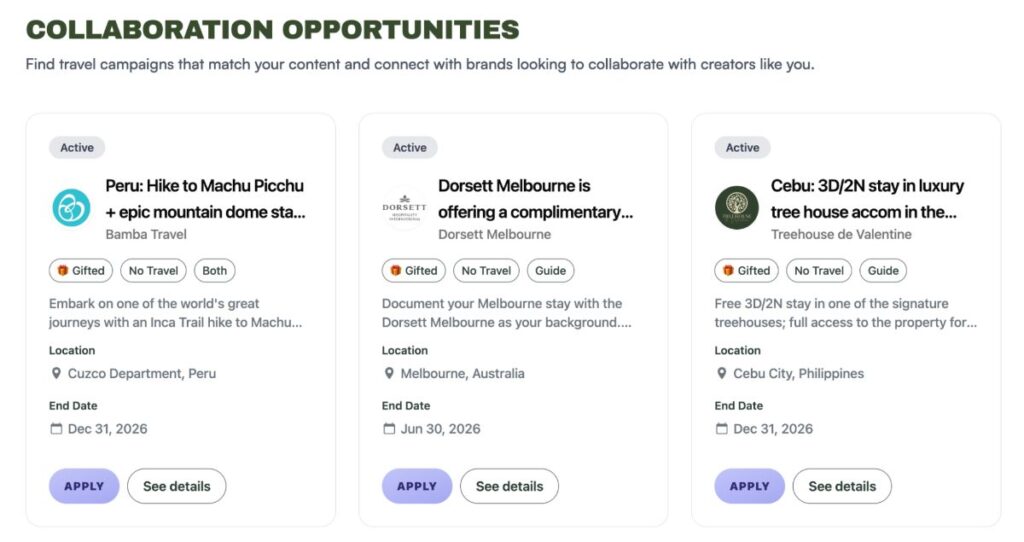
The influencer marketing landscape has matured significantly for digital marketing for travel. While mega-influencers offer reach, micro-influencers (typically 10,000-100,000 followers) increasingly deliver superior customer engagement and conversion metrics for travel brands. These niche creators maintain authentic connections with specific audiences, adventure travelers, luxury seekers, family vacationers that translate to higher trust and booking action.
Effective partnership frameworks extend beyond one-off sponsored posts. Long-term ambassador relationships allow influencers to develop genuine familiarity with destinations and experiences, creating content marketing that reflects authentic experience. Companies like Videreo connect influencers directly to tour operators, demonstrating the rising demand for influencer partnerships across all business sizes.
Harness User-Generated Content at Scale
User-generated content (UGC) represents your most valuable and cost-effective marketing asset. Photos, videos and reviews created by actual travelers carry authenticity that branded content simply cannot replicate. This is particularly powerful as social proof, potential customers trust peer recommendations far more than polished marketing campaigns.
Some OTAs have formalised this strategy at scale, such as TourRadar with their Moments program, which systematically captures and redistributes traveler content across their marketing ecosystem. The principle is simple: real travelers telling real stories converts better than brand copy. Operators can adopt the same model on a smaller, but highly effective, scale.
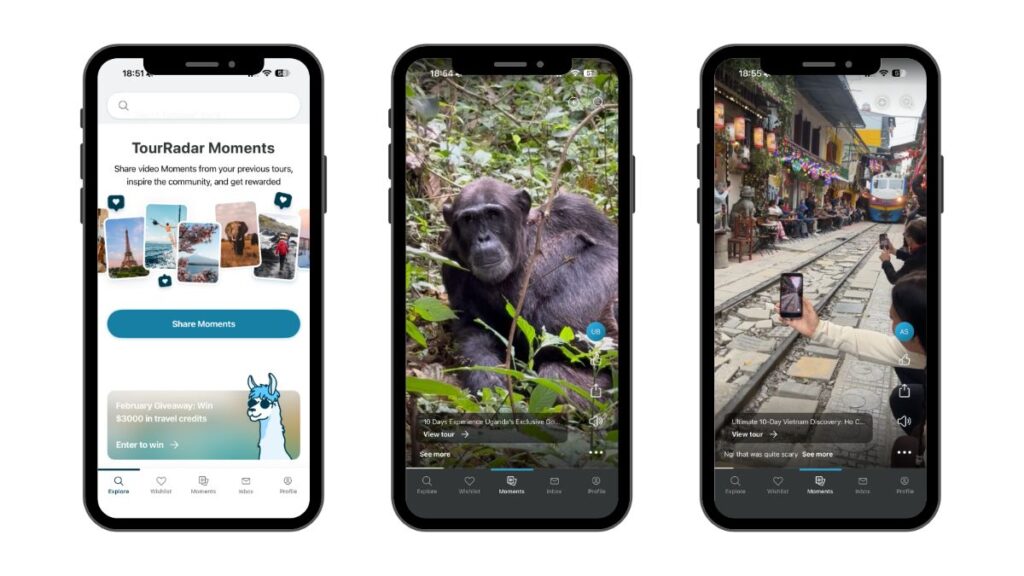
You can take passive and active approaches to collecting content. Passive methods include monitoring branded hashtags, location tags and review platforms for organic mentions. Active strategies encourage content creation through contests, incentives and direct tasks. Post-experience email sequences prompting reviews and photo sharing capture travelers while their memories remain fresh. If you have a fixed location like a cooking class, setting up photo-friendly corners with props makes UGC collection significantly easier.
Capturing customer interviews on-site can provide you with particularly strong content. By simply asking guests what they enjoyed most and recording their authentic reactions, you can create powerful social media content that works across platforms and on product pages to boost conversions. This behind-the-scenes approach consistently outperforms scripted testimonials.
Example of a high quality testimonial from Enjoy Cooking in Rome interviewing a customer with combined footage of the experience.
What to Do Next
- Set up automated UGC collection systems through social listening tools such as Sprout Social or Orlo or build simple custom automations.
- Conduct quick on-site customer interviews: ask guests what they enjoyed most and capture their reactions on video. This content consistently outperforms scripted testimonials across platforms.
- Tailor content to each platform’s format — short-form video for discovery, carousels for education, Stories for real-time engagement — rather than posting the same asset everywhere.
- Partner with micro-influencers who genuinely align with your brand values, and measure success by bookings generated, not likes or views.
Priority 3: Use Data-Driven Marketing Strategies That Actually Drive Conversions
Data is a powerful tool that most operators underutilize, and it’s not hard to see why. As travelers move across multiple touchpoints, from AI assistants to social media platforms to online booking sites and beyond, keeping track of it all can feel overwhelming.
But the operators who figure this out don’t just save time. They make smarter financial decisions. Your data can tell you which marketing channels are actually driving bookings, which customer segments are most likely to return, and exactly where you’re losing people in the purchase journey. That’s not a nice-to-have, it’s the difference between growing with confidence and guessing your way through budget decisions.
The goal is a single source of truth: one place that brings together your customer information, booking patterns and marketing performance so you can finally see the full picture.
So how can you take control of your data and ensure you’re using your marketing budget wisely?
Map the Complete Customer Journey
Traditional single-touch attribution no longer captures how modern travelers actually make decisions. Even the 38 website rule is a thing of the past. A guest might discover your experience through Instagram, scroll reviews on Tripadvisor, research via ChatGPT, then book through an app on their mobile phone after receiving a retargeting ad all without landing on a traditional website.
Attribution tells you where a booking came from. Behavioral analytics tools show you what happened once the traveler arrived. Platforms like Microsoft Clarity provide free heatmaps and session recordings that reveal how users actually interact with your website. You can see where visitors hesitate, where they abandon the booking flow, which elements attract attention and where friction occurs.
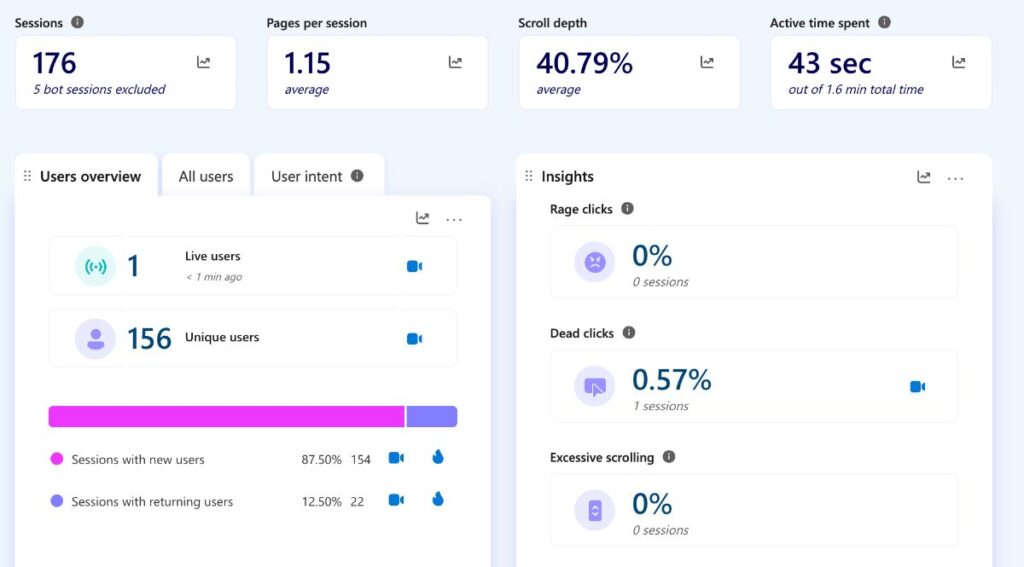
Rather than crediting a single source for a booking, tracking tools help you understand how travelers move through multiple interactions before converting — for example by using UTM parameters, dedicated promo codes or platform-specific landing pages.
Understanding this full customer journey, not just the final click, will enable you to make much smarter digital marketing decisions about where to invest your budget.
Adapt to Cookie-Less Tracking
If you’ve been relying on tracking pixels and third-party cookies to measure your marketing, you’re likely already seeing gaps in your data. Safari and Firefox block third-party cookies by default, and while Google’s planned deprecation in Chrome has been paused, the direction of travel is clear, operators who depend on traditional tracking methods are building on an increasingly unstable foundation.
The most reliable data comes from relationships you own directly. Building an email list, encouraging account creation and offering something of value in exchange for contact details, a discount code, a destination guide, early access to new tours, gives you first-party data that no privacy update or algorithm change can take away.
On the technical side, ask your booking platform or web developer about server-side tracking, a method that records conversions through your own systems rather than relying on browser cookies. It’s more accurate, more durable and increasingly the standard.
There’s a competitive upside here too. Guests share personal information at genuinely sensitive moments, payment processing, special requests, day-of logistics. When you’re transparent about what you collect and why, that trust becomes a direct booking advantage. It’s one more reason a traveler chooses your website over an OTA.
Operator Takeaway: Add an email capture incentive to your website, ask your booking platform about server-side tracking and add a brief data transparency statement to your booking confirmation. These three steps protect your measurement capability and build the kind of trust that keeps guests coming back directly.
Use Predictive Analytics for Demand Forecasting
Predictive analytics and data analytics enable you to anticipate demand rather than merely react to it. Machine learning models analyze historical booking patterns alongside external factors such as weather forecasts, local events, school holidays and economic indicators to forecast digital marketing trends with increasing accuracy.
The applications for operators are immediately practical:
- A walking tour operator might use historical data to predict that bookings spike two weeks before bank holidays, allowing them to increase paid digital advertising spend at precisely the right moment.
- A food tour company could identify that rainy weather correlates with last-minute bookings, triggering automated promotional campaigns.
- A cultural attraction could analyze historical visitor data alongside local event calendars and school schedules to anticipate demand weeks in advance — then apply dynamic pricing, raising ticket prices during peak periods and offering early-bird discounts to fill quieter slots.
Platforms like FareHarbor and Peek have both invested in AI-powered forecasting tools. Peek’s CoPilot uses AI to surface demand patterns and recommend dynamic pricing adjustments in real time. Operators looking to go further can layer in additional signals like Google Trends and local event calendars to build an even sharper picture.
Implement Dynamic Pricing Strategies
Every unsold spot on a departure is revenue you can never recover. And every tour that sells out weeks in advance is a signal you probably priced it too low. Dynamic pricing addresses both problems, automatically adjusting what you charge based on real-time demand, booking pace and remaining availability.
Dynamic pricing tools enable operators to adjust prices in real-time based on demand signals, remaining availability and booking pace. A food tour approaching full capacity, for example, might automatically increase prices for the final spots. Meanwhile, a tour with low bookings could trigger automatic discounts to fill remaining capacity and maximize revenue per departure.
Online booking platforms like FareHarbor, Ventrata, Peek and Bókun offer built-in dynamic pricing tools. For more sophisticated control, specialized tools like Aloja AI or Digonex provide advanced pricing optimization.
What to Do Next
Many operators sit on valuable data without realizing it. Don’t be one of them! Try one or more of these strategies today:
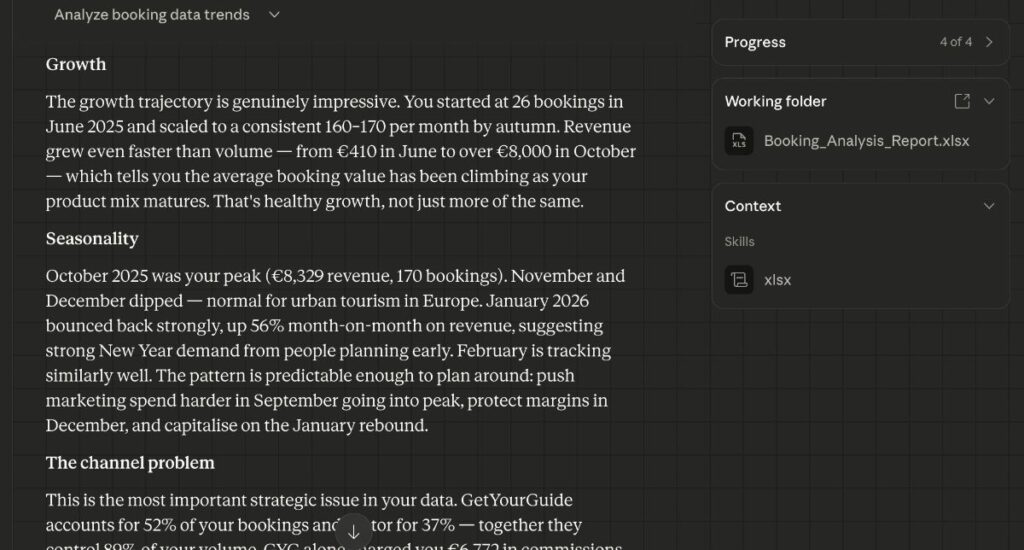
- Download three years (or as much as you can) of booking history, combine it with customer reviews and website analytics. Then use AI tools like Claude or ChatGPT to identify seasonal patterns, pricing sweet spots, and demand cycles.
- Set up multi-touch attribution using UTM parameters, dedicated promo codes, and platform-specific landing pages so you can see the full booking journey, not just the final click.
- Test dynamic pricing on a single high-demand experience first to understand the revenue impact before rolling it out more broadly.
Join us at an upcoming Arival event to connect, learn, & grow your tours, activities, & attractions business
Priority 4: Use Sustainability to Stand Out
The word “sustainability” has a perception problem. Research shows it ranks surprisingly high as something travelers say they care about yet it rarely converts the booking.
Yet something more commercially significant is quietly happening: the experiences growing fastest right now are rooted in real places, real people and genuine community relationships, and with the rise of AI-generated content, this will become even more important. Travelers are gravitating towards hidden gems, so, the family-run restaurant, the local artisan, the guide who knows the neighborhood by name. This is a form of sustainability in practice, even if nobody uses the word.
James Thornton, CEO of Intrepid Travel, described the dynamic plainly in a recent conversation on The Best Part of Travel podcast: “I don’t know a customer who says, ‘I want sustainability as my number one criteria.’ First and foremost, a customer wants to have a great holiday. But more and more, the expectation is that travelers also expect to have stronger purpose-led credentials as a result of their trip.”
Intrepid has grown at a compound annual rate of 20 percent since the pandemic, doubling in size. Thornton attributes that growth directly to the company’s commitment to purpose and community investment, not as a marketing layer, but as core product design. This is the takeaway for operators at any scale: sustainability isn’t simply good for messaging. It’s good for business.
Build Authentic Community Partnerships
True sustainability goes far beyond environmental measures — it overlaps with the types of authentic experiences travelers are looking for. Travelers seeking “hidden gems” aren’t just looking for off-the-beaten-path locations, they’re looking for access to real people and real relationships that feel unavailable to everyone else. As an operator, your local partnerships are that access.
Cookly as a brand does a great job showcasing local culture and local experiences in real peoples homes.
Start by mapping the community members who are already part of your experience: the restaurant your guides trust, the artisan who demonstrates their craft, the neighborhood market guests would never find alone. These aren’t just nice local touches, they are competitive assets your competitors cannot easily replicate. When guides can introduce travelers to real people alongside places, and explain the story and significance behind those relationships, the experience becomes distinctly more meaningful. Guests remember the people they met far more vividly than the facts they were told.
This dynamic also generates powerful marketing assets. Authentic partnerships can facilitate behind-the-scenes moments, partner interviews and unscripted interactions that consistently outperform polished promotional content on social media. User-generated content rooted in genuine community relationships carries a credibility no brand-produced video can match.
From a commercial perspective, deep community ties unlock structural advantages: preferential access to venues, better wholesale pricing from local suppliers, cross-promotional opportunities and private experiences unavailable to competitors.
“By investing in local, by investing in purpose, it’s helped strengthen our business success,” says Thornton. Collaboration isn’t a sustainability checkbox, it’s infrastructure that improves your product, strengthens your marketing and enhances your long-term business viability.
What to Do Next
- Feature your local partners prominently in your content marketing. Introduce the family restaurant, the independent artisan, the neighborhood gem, and explain what those relationships mean for the community. This is the “hidden gems” content travelers love to share.
- Track two or three sustainability metrics you can report right now: percentage of local spend, waste diverted, carbon per traveler. Concrete numbers beat vague green claims every time.
- Create behind-the-scenes content: guide introductions, partner spotlights, day-in-the-life posts that show your sustainability and local partnerships in practice. Travelers who see it in action trust it far more than an obligatory paragraph on a website.
- Learn more about building community partnerships here:
Priority 5: Automate Marketing Operations Without Losing the Human Touch
If marketing feels like the part of the business you never quite have enough time for, you’re not alone. Most operators are running experiences, managing staff and responding to guests, marketing gets squeezed into whatever’s left.
Marketing automation changes that equation. It removes the constant manual decisions, who to target, when to send, what to offer, so your campaigns keep working even when you’re fully focused on delivering a great experience. And when done well, it still feels personal to the traveler on the other end.
Deploy AI-Powered Automation Strategically
Artificial intelligence is increasingly able to handle tasks operators previously managed manually: audience segmentation, send-time optimization, content personalization and campaign performance adjustments. In practice, this means you’re sending fewer generic broadcast messages and more timely, context-aware communication that aligns with how travelers actually research and book experiences in the travel industry — meeting travelers where they’re at
The rise of on-platform marketing ecosystems is reinforcing this shift. Tour operators are now able to automate conversations directly within Instagram, Facebook Messenger, and WhatsApp by using tools like ManyChat. These systems can respond to customer inquiries, answer common questions, surface real-time availability, and upsell relevant experiences without pushing users to external email funnels.
As discovery, conversation, and online booking increasingly happen within the same social media platform, this automation becomes fundamental to delivering a seamless customer experience.
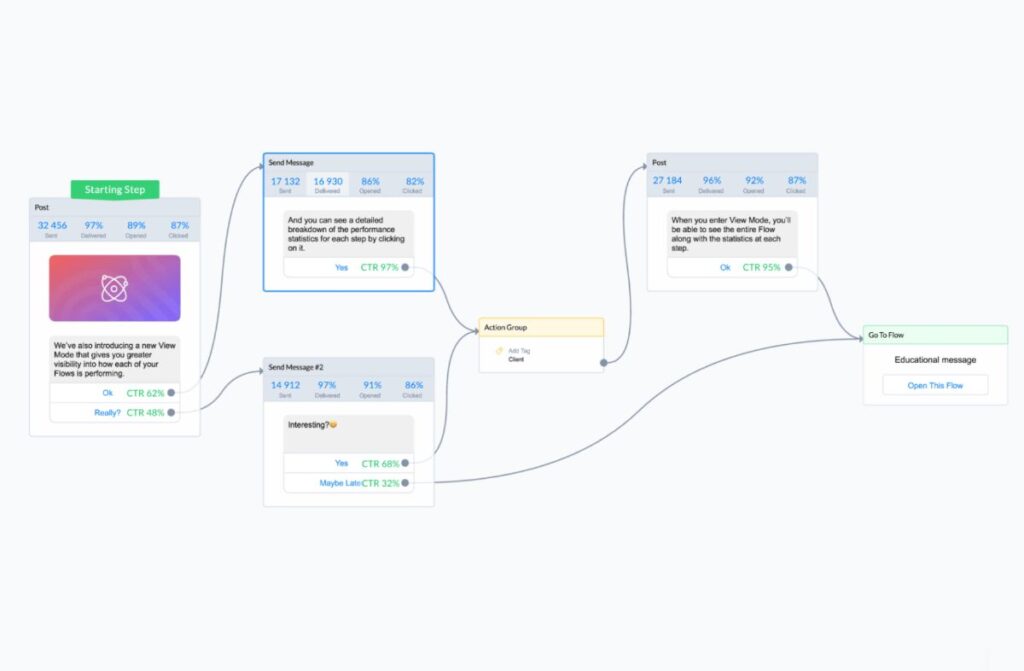
AI agents represent the next evolution in marketing automation. These systems can monitor signals like booking pace, weather forecasts, local events or competitor pricing changes, then trigger marketing actions automatically. For tour operators, this might mean promoting indoor experiences when rain increases demand, scaling paid ads for tours filling faster than projected, or pausing campaigns when availability drops.
The value lies in saving yourself and your operations team from repetitive tasks and decision-making, and in reducing cancellations and improving profitability by better responding to travelers’ needs in the moment.

Integrate Your Technology Stack
Marketing automation only delivers real business value when your systems are properly integrated. For tour operators, this means your marketing tools should connect tightly with your booking engines, availability calendars, CRM platforms, and customer support systems. Without integration, automation creates noise and confusion rather than operational leverage.
Operators see the greatest benefit when booking and customer data flows automatically into marketing and communication tools. This enables confirmation messages, reminders, review requests, upsell offers and follow-up sequences to trigger based on actual guest behavior rather than static schedules. It also ensures your messaging stays aligned with real-time availability and operational reality.
What does an ideal operator tech stack look like? It will be different based on your needs and situation, of course, but here’s a good place to start: Future Proof Your Business with a Smart Tech Stack.
What to Do Next
- Automate post-booking sequences: confirmations, pre-experience reminders, review requests, and relevant upsell offers.
- Set up ManyChat or similar platforms to handle common social media inquiries automatically.
- Test AI-powered campaign triggers based on booking pace, weather forecasts, or local event calendars.
- Optimize your tech stack: Ensure your booking system integrates seamlessly with email marketing platforms, CRM tools, and analytics systems.
Moving Forward: Your Digital Marketing Action Plan
The travel marketing landscape in 2026 is fragmented: travelers are searching for experiences in a myriad of different places. Discovery now happens across AI assistants, short-form video, voice search and traditional channels simultaneously.
Your potential customers’ booking paths are non-linear. Attribution, determining how customers came to you through conventional digital marketing methods is harder than ever. Yet demand for tourism experiences has never been stronger, and the tools available to independent operators have never been more powerful.
Thriving in this environment does not require an extensive knowledge of digital marketing or the biggest marketing budgets. It simply requires building adaptable foundations, taking decisive action, and maintaining direct relationships with your customers. The gap between operators who embrace these digital strategies and those who don’t is widening rapidly.
Here are some final tips to get your digital marketing strategy on the right track for 2026:
1. Audit before you add. Before investing in new channels, review what you already have. Most operators lose bookings not from lack of demand but because their existing funnel leaks conversions.
2. Own your data. Build first-party relationships through email capture and direct booking incentives. Data you own can’t be taken away by algorithm updates, platform changes or cookie deprecation.
3. Forecast demand, don’t just react to it. Use your booking history alongside local events and seasonal signals to predict when demand will spike, then time your spend to match.
4. Let pricing do some of the work. Dynamic pricing fills quiet departures and maximizes revenue on popular ones. Even basic tools can automate adjustments you’d otherwise make manually.
5. Automate the routine, protect the human. Marketing automation handles the repetitive decisions, who to email, when, with what offer, so your time stays focused on delivering experiences worth talking about.
The opportunity for tour and attraction operators who optimize their marketing strategy is substantial. Traveler demand is at record levels and digital marketing tools available to independent businesses have never been more sophisticated. Whether you’re starting a tour business from scratch or scaling an established operation, these five digital marketing priorities provide a clear strategic path forward for 2026 and the years ahead.
About the Author

Oliver Green is an Arival Insights Contributor and regular speaker at Arival events. As a travel and tourism consultant and operator, he specializes in automation, AI, and scalable systems for tour companies. He helps operators increase direct revenue, reduce operational overhead and modernize their tech stack.
Take Your Digital Marketing to the Next Level
Learn more about the latest insights in digital marketing at an upcoming Arival event, where Oliver Green and other industry experts will be leading sessions and workshops on a variety of topics to help operators of tours, activities and attractions level up their digital marketing skills and strategy.
Become an Insider Pro Access member today and get access to the full library of Arival research, plus many other benefits such as free consulting sessions, special discounts and 20% off in-person events, starting from $179 per year.
Sign up to receive insights tailored for the in-destination industry as well as updates on Arival.