
A guest books your walking tour through an online travel agency (OTA). You pay the commission, your guide does a great job and everyone leaves happy. The next evening, that same guest takes a food tour with a different company. You run one too. They just didn’t know about it.
For operators, guest lifetime value can start with something as ordinary as that missed booking. A second purchase doesn’t have to mean waiting for a traveler to return next year. They may still have several days left in town.
Arival research on the experiences market reveals a pattern: although spending is flat or down in the U.S. and Europe, travelers are still booking more experiences. The opportunity for tour, activity and attraction operators is to capture more share of each guest’s trip. That could mean upgrading the visit they have already booked or helping them plan another day with a complementary experience. The useful question is how to earn more of their business while making the trip better.
There are a few places to start: checkout, the confirmation email you already send, the days before arrival and conversations with guides or visitor-facing staff. Here’s how to use those moments to offer something relevant without overdoing the sales pitch.
Guest Lifetime Value: What Is a Guest Worth Beyond the First Booking?
Guest lifetime value is the value of someone’s business over the whole customer relationship. That includes the first tour or attraction ticket and anything else they buy from you, whether it’s an upgrade today (i.e. upselling) or another experience on a future trip (i.e. cross-selling).
The distinction between upselling and cross-selling is straightforward. Moving a couple from a group departure to a private tour is an upsell. Selling them a cooking class to go with their market tour is a cross-sell. At an attraction, moving from standard admission to a ticket with faster entry or more flexible arrival is an upsell. Adding a separately priced workshop or a visit to a partner attraction is a cross-sell.
How to calculate guest lifetime value
You don’t need a sophisticated forecast to get started. Divide revenue over the past 24 months by the number of unique customers who generated it. That gives you revenue per customer for the period. A lifetime-value forecast goes further, estimating what those customers will spend in the future and how long they’ll keep buying.
Revenue per customer over 24 months
Revenue from those customers ÷ Unique customers in the same period
Illustrative example: $120,000 ÷ 1,000 = $120 per customer
Use unique lead bookers if that is what your booking system can identify. This measures past revenue per customer; a lifetime-value forecast estimates future purchases too.
There’s a catch with tour and attraction bookings: the person paying may be booking for a whole group. If your system only identifies the lead booker, use that as your unit of measurement. Counting all six passengers as separate customer relationships will give you a misleading number.
Revenue is only part of the picture. A second booking still costs something to deliver, especially if you’ve offered a discount or promised a guide bonus. Work out what’s left after those costs. Track referrals separately unless you can reliably connect them to the customer who sent them.
Arival’s Operator’s Marketing Playbook describes rising digital marketing costs and pressure on operators’ acquisition channels. That makes understanding the value of existing relationships especially useful when deciding where to invest.
AI Insights Tip: You can use Claude or ChatGPT to help work out these numbers. If you use a booking system such as FareHarbor or Bókun, check whether a supported connector can give your AI tool access to the booking history you need. Availability and access vary by setup. Alternatively, download your booking data or reports as CSV or Excel files and upload them to Claude or ChatGPT, then ask your questions in plain English.
Try this prompt: “Using the past 24 months of bookings, calculate revenue per unique lead booker, the percentage who booked more than once and the tours most often bought by the same customer. Exclude canceled bookings, account for refunds and keep currencies separate. Show your calculations and flag any missing data. If delivery costs and commissions are included, also show what’s left after those costs.”
Use a consistent customer ID to match repeat bookers across bookings. Check the revenue total against your booking report before relying on the results.
Illustrative AI output
The answer: £46 revenue per customer. That’s £235.8k of live booking value across 5,128 unique customers.
For 2026 alone, it’s £48 (4,415 customers, £210k).
Illustrative analysis from the draft’s Claude-generated fictional dataset. Rounded figures; reporting periods differ from the 24-month example above. Note: these are examples, not actual operator results.
Treat the AI analysis as a starting point: revenue over the reporting period is not a lifetime-value forecast, and repeat bookings alone don’t establish what prompted the purchase.
Operator Takeaway: Look at what customers spend with you and how many buy a second time within the same period. Check what you earn from those extra purchases after delivery costs and incentives.
13-15 April 2027 Insider Pro Access Members Save 20% THE event of the year for the European in-destination experiences industry Save up to €850 with an Autumn Advantage Ticket as an Insider Pro Member!
Four Practical Ways to Increase Guest Lifetime Value
1. Make a Relevant Offer at Checkout and in the Confirmation
The first opportunity can come before the confirmation email. If your reservation or ticketing system supports checkout offers, suggest one relevant upgrade or additional experience while the guest is booking. According to Arival’s latest experiences traveler research of 2,550 U.S. and European travelers, nearly three in four travelers expressed interest across seven potential attraction upsells. That is evidence of interest, not a forecast of how many of your guests will buy.
In the “Bundle and save” example below, adding another experience unlocks a 20 percent discount on both. The guest can select the extra tour and choose its date in the next steps. This is a cross-sell within checkout, so they don’t have to return later to start a separate purchase.
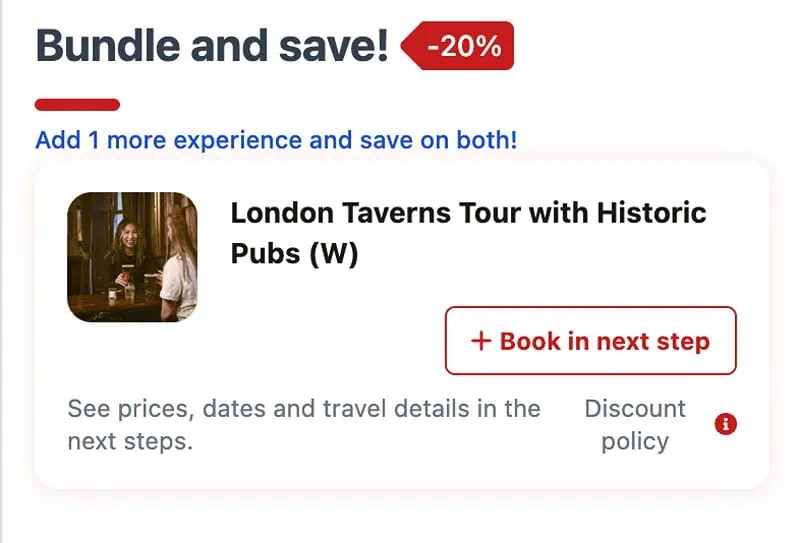
Check the margin on the whole bundle: the discount applies to the original experience as well as the extra one. Keep the offer optional and make the combined price and terms clear before payment. Track whether it increases earnings per booking and whether more guests leave checkout without completing their purchase.
Guests open a confirmation to check that they’ve booked the right thing and find out where to go. Answer those questions first. The meeting point should never be buried below an offer.
Below the booking details, there’s room for a relevant extra. Hotel pickup makes sense when the departure point is awkward to reach. A private upgrade may appeal to a family that wants to move at its own pace. Choose something with an obvious benefit for the person receiving the email. For an attraction, test a flexible-entry upgrade for visitors with uncertain schedules, or a food-and-drink package for a longer visit. State what is included and what costs extra; check that your team can deliver the promised benefit.
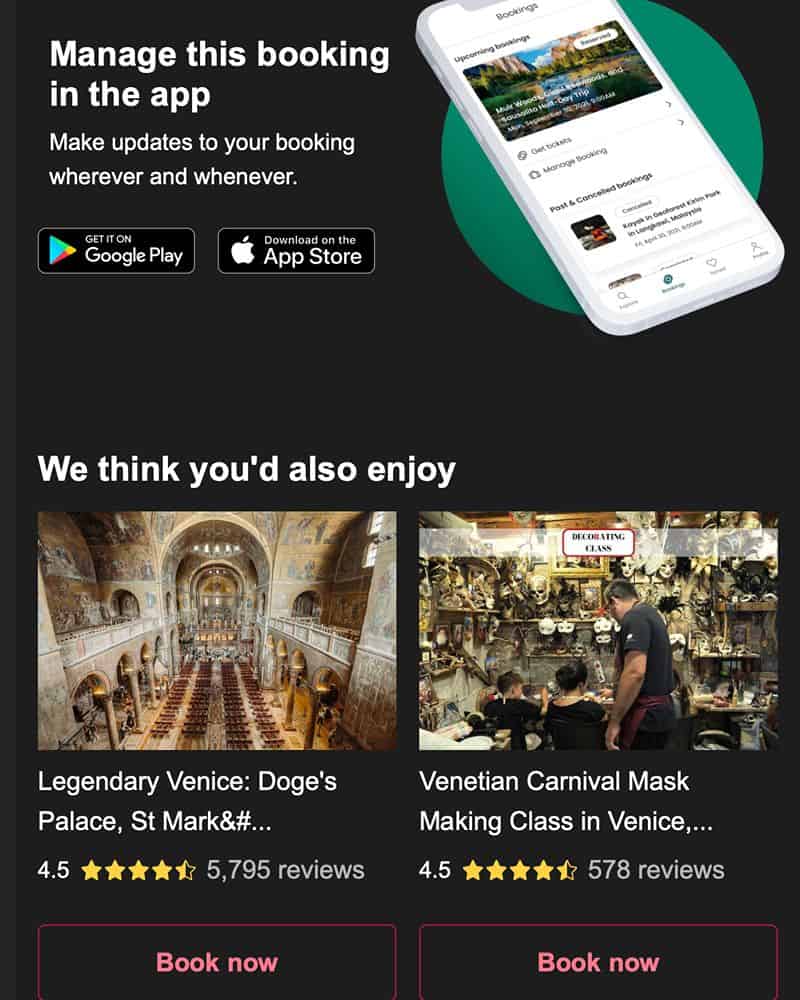
A recent Viator booking email for a Venice experience shows this in practice (see below). Below the booking-management information, a “We think you’d also enjoy” section recommends other Venice experiences, with photos, ratings and “Book now” buttons. This is cross-selling: the guest has already booked, and the email gives them a way to plan another part of the trip. Viator shows two options here; an operator can start with one well-matched recommendation from their own range.
There is evidence for testing messages triggered by customer behavior. In its 2026 analysis of email automation, Omnisend reported that automated emails accounted for 30 percent of email-attributed revenue from 2 percent of sends in 2025. Those findings cover ecommerce and several automation types; they do not establish an expected conversion rate for tour confirmations.
Be specific about what you’re selling. “Add hotel pickup” is clearer than “Enhance your experience.” Include the price and a link to buy it. If pickup needs to be arranged a day ahead, say so; there’s no need to invent urgency.
Send offers in line with the permissions guests have given you and the terms of the channel they booked through. They should be able to stop receiving promotions without losing essential information about their tour.
To find out whether it works, compare guests who receive the offer with a similar group who receive your usual confirmation. Run both at the same time if you have enough bookings. Comparing August with September could tell you more about the season than the email.
Operator Takeaway: Add one offer to the confirmation for one product. Track the extra purchases and what they earn after costs, while watching for unsubscribes.
2. Time Your Messages Around the Guest’s Trip
Someone booking three weeks ahead has time to browse another experience. Someone arriving tomorrow probably needs directions. Sending both guests the same message sequence is asking for trouble.
Start with your own booking data. Look at how far ahead customers reserve your highest-volume products and identify where there is enough time for a useful recommendation. Arival’s 2026 U.S. Experiences Traveler Outlook examines booking windows, but your product-level patterns should determine when your messages go out.
For an early booking, you could send the confirmation straight away, recommend another experience a few days before arrival and send the final logistics the day before the tour. Late bookings can skip the middle message. Don’t squeeze a week’s worth of emails into one afternoon.
Your offers should also change as the guest makes decisions. If they’ve already added something on, such as a pickup, generic emails asking them to buy it miss the mark. A suggestion for an evening food tour might be more useful now, provided it fits around what they’ve booked.
Look for products customers already buy together. If you don’t have enough data, use what you know about the itinerary: a morning market visit and an evening cooking class may fit, while two similar walking tours on the same afternoon won’t. A museum could pair daytime admission with an evening event or a partner walking tour, leaving enough time to travel between them.
Arival’s The Latin American Experiences Traveler research adds another reason to think beyond the first booking in your messaging. Travelers surveyed in Argentina, Brazil and Mexico take fewer trips than their U.S. and European counterparts, but longer stays in Argentina and Brazil create opportunities to sell more than one experience to Latin American travelers working within a constrained budget. For them, test a clearly priced family bundle, such as attraction admission paired with a local tour on another day, making the total cost, inclusions and any potential savings clear before booking. Show the individual prices beside the bundle price, say whether each is per person or for the whole family, and list what is included.
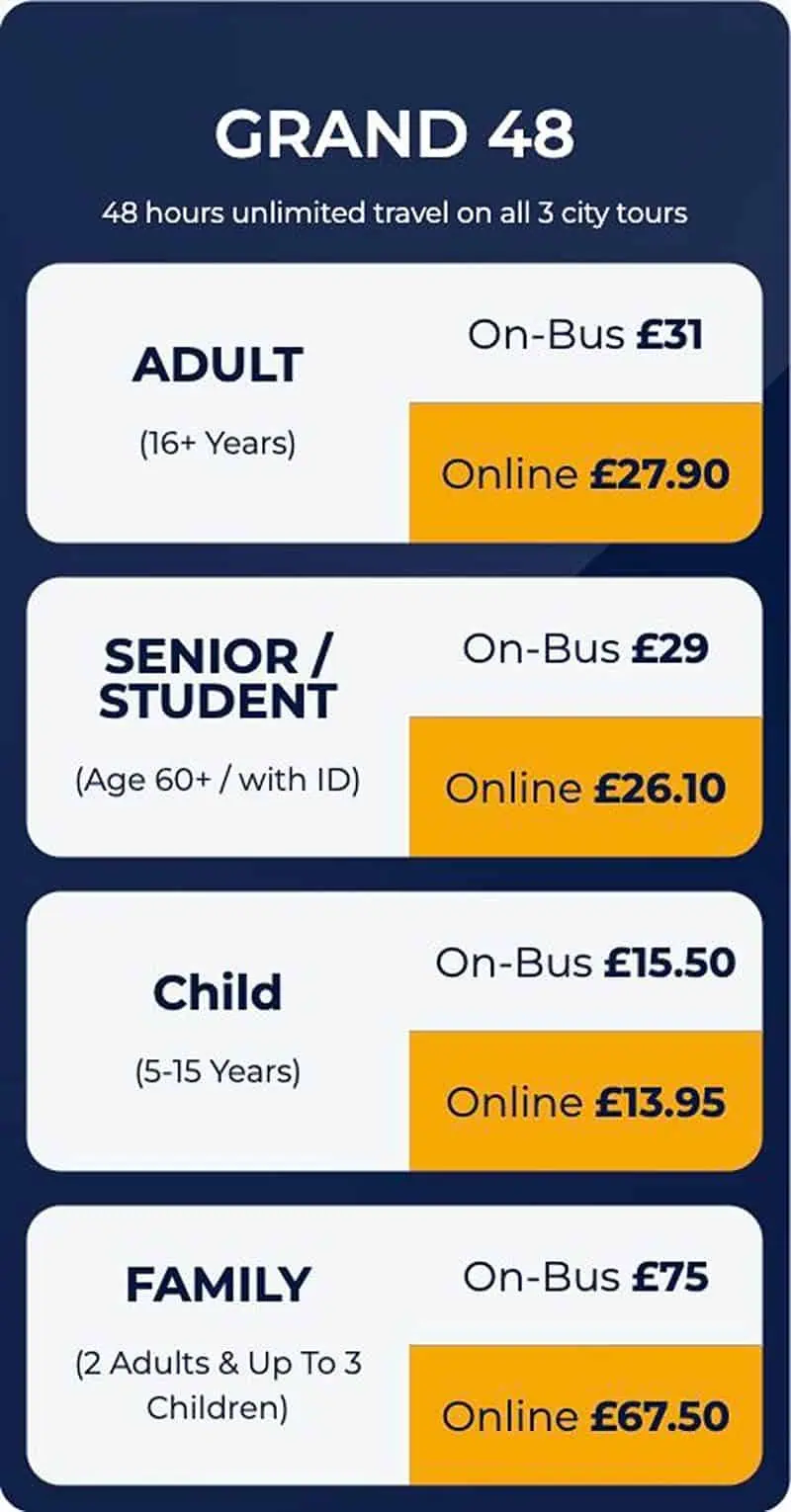
Edinburgh Bus Tours’ Grand 48 pass shows a whole-family bundle in practice. It covers two adults and up to three children aged 5–15, with 48 hours on all three city tours. The page lists online prices of £27.90 per adult, £13.95 per child and £67.50 for the family. For two adults and two children, individual Grand 48 tickets total £83.70, so the family ticket saves £16.20. Prices and availability may change.
Use the channels guests have chosen and agreed to hear from you on. Before paying for another messaging tool, check what your reservation system can do. You’ll need it to recognize cancellations and additional purchases, and to avoid promoting departures that are already full.
Set up an internal notification when a larger group books, too. Choose a group-size threshold that makes sense for your tours and route the alert to someone in reservations or sales, with the booking details and departure date. That gives them a chance to offer a private upgrade, arrange a group transfer or suggest another experience while the organizer is still planning. Check what suits the group before reaching out.
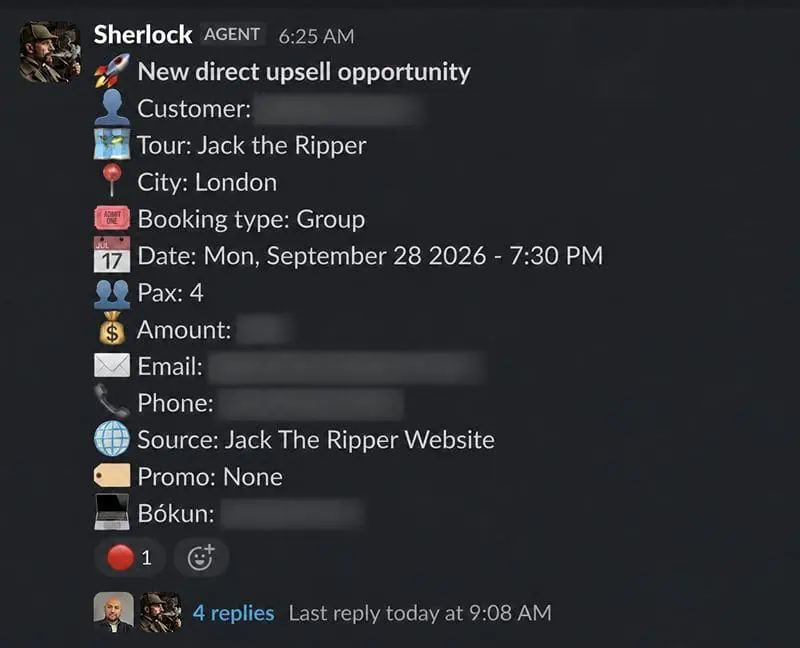
Send yourself the whole sequence and open it on your phone. Follow every booking link. It’s worth discovering an awkward checkout before your guests do.
Operator Takeaway: Try a new message sequence on your busiest product, with a shorter version for late bookings, and set an internal alert so someone can follow up with larger groups. Track second bookings from both approaches and ensure your messaging isn’t showing guests offers they’ve already bought.
3. Give Guests a Reason to Stay in Touch
Think about the questions guests ask during a tour. Where should we eat tonight? Can you send us that recipe? Do you have a map of these places? Each is a good reason to offer something they can take away. At an attraction, a family activity pack or a guide to the exhibits can serve the same purpose.
Here are some ways you can do this in practice:
- Put a QR code on a tasting card, guide’s badge or attraction exit sign and link it to a simple page where guests can request the resource. Ask for as little information as possible. Nobody wants to complete a long form while the rest of the group waits.
- Make future marketing a separate choice on that page. A guest who wants the recipe may also want your recommendations and offers, but let them decide. Explain what they’ll receive before they subscribe.
- Keep a record of those preferences and make it easy to unsubscribe. That’s a better foundation for an email list than collecting addresses from people who only wanted a copy of the map.
- Help guides introduce the invitation naturally: “This map has the places we’ve talked about today. Scan here if you’d like a copy.”
- Let the guide choose a sensible moment. After a tasting is a good time to offer the recipe. When someone asks where to go next, offer the map. There’s no reason to interrupt the best part of a tour to ask for an email address.
- Once the page is running, look beyond the signup total. Are people choosing to hear from you again? Do those subscribers go on to book? That will tell you whether the resource is helping you build a useful audience.
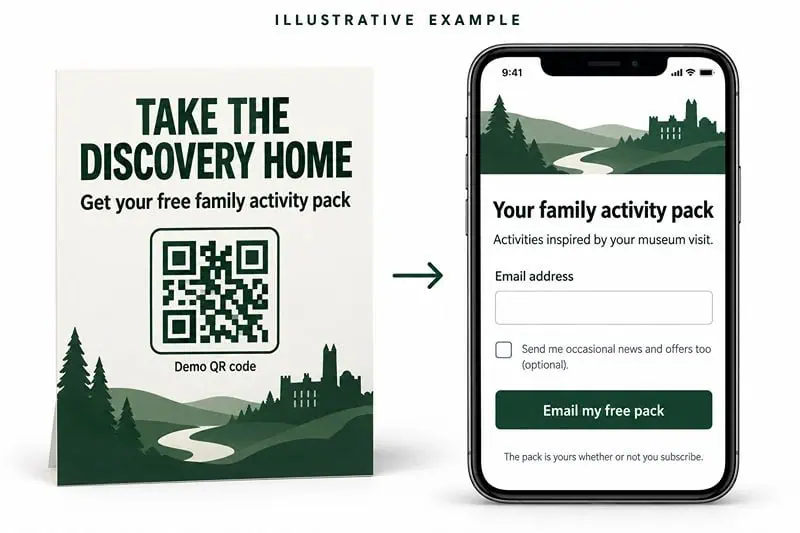
Operator Takeaway: Start with one resource guests already ask for. Give guides a simple way to share it, then track how many guests subscribe and later book.
4. Turn Guide Recommendations Into Follow-Up Bookings
By the end of a tour, a guide may know that a guest loves cooking or has a free evening tomorrow. That gives them a much better starting point for a recommendation than a generic list of your other products. At attractions, hosts and visitor services staff can do the same: recommend a workshop that fits a family’s interests or a partner experience for a day they still have free.
Help guides get familiar with the experiences they’re recommending. They need to know who will enjoy them and how they fit into a visitor’s day. Ideally, let them try the product so they can explain it in their own words.
Equip guides with a short booking link or a QR code they can share on a card or from their phone. Point it straight to the recommended experience, and give each guide a unique link or code so you can track the bookings they bring in.
A commission gives guides a reason to make those recommendations consistently. You could pay a fixed amount per completed booking or a percentage of the sale, with the guide’s link or code handling attribution. Set a rate your margins can support and be clear about when it’s paid and what happens after a cancellation. Keep an eye on guest feedback as well as sales.
AI Insights Tip: You could also vibe code a simple landing page: describe what you want to an AI coding tool and use it to build a page with the guide’s recommended experiences and links to your existing checkout. Arival’s 5 Vibe Coding Examples Every Tour Operator Can Use shows how a custom guest hub can work. Link the guide’s QR code to that page and test the booking journey on a phone before sharing it.
You don’t have to lead with a discount. First see whether a good recommendation is enough. If you do offer one, check what you’ll earn after the discount, any guide bonus and the cost of running the experience.
A follow-up message can pick up the recommendation later, where the guest has agreed to receive marketing. Keep it focused. If you also owe them photos and want a review, think about the order of those requests instead of asking them to do everything at once.
Guest communication apps from companies such as TourOptima can help you manage guest conversations and send upsell or cross-sell offers through the same system. Automate.travel offers similar guest-communication and automated upsell services alongside its tour operations tools. Check how each connects to your booking system and which channels your guests will use.
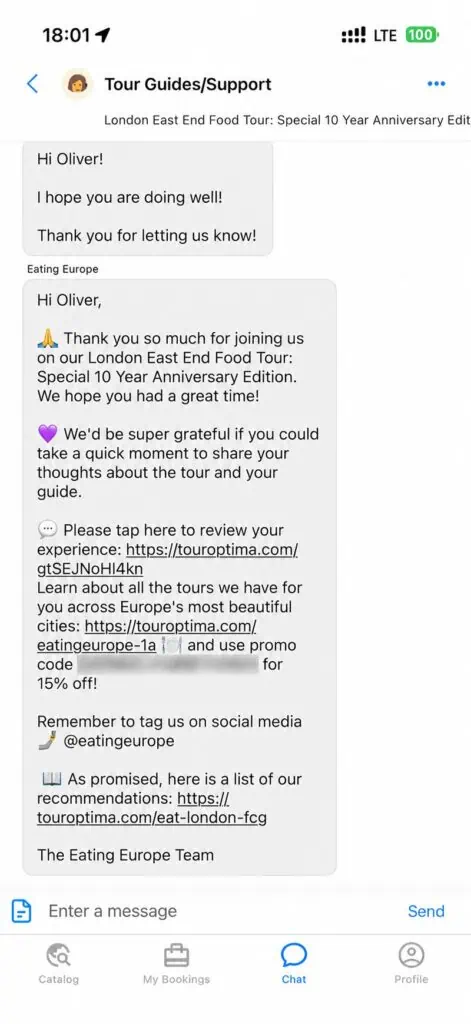
The example below shows a post-tour message received inside TourOptima’s guest app, in its Chat section. It offers 15 percent off another experience with the same company and links to the tours, alongside a review request and local recommendations. TourOptima can also send email, WhatsApp and SMS; the screenshot here shows its in-app chat. Test whether a separate offer performs better for your guests.
It’s tempting to send everyone toward a departure with empty seats, but that’s only sensible when the fit is right. Check that the guest will still be in town and that the experience offers something they haven’t just done, in order to make your messaging effective.
Operator Takeaway: Give a few guides one experience to recommend, a trackable QR code or link and a clear commission offer. Review the completed bookings, earnings and guest feedback before rolling it out more widely.
13-15 April 2027 Insider Pro Access Members Save 20% THE event of the year for the European in-destination experiences industry Save up to €850 with an Autumn Advantage Ticket as an Insider Pro Member!
Where to Start
Operators leave money on the table when they treat each guest as a one-time transaction. Relevant upselling and cross-selling can increase what a guest spends with you, help them plan more of their trip and turn a first booking into a longer relationship. The value is the extra business you earn after discounts, commissions and delivery costs.
Start with one product and one offer. Use your booking data to choose a relevant upgrade or complementary experience, add it below the essential details in your confirmation email and compare the results with your usual confirmation. Track extra purchases, earnings after costs and guest feedback across enough departures to judge the result.
Put someone in charge of checking the offer. Prices change, departures fill up and links break. An automated email still needs the occasional look from the person who knows what’s happening on the ground.
If the offer earns worthwhile business and helps guests, extend what works to pre-arrival messages or guide recommendations. You do not need an elaborate funnel to begin: one useful offer, delivered at the right moment, is enough to test whether you can earn more of each guest’s trip.
About the Author

Oliver Green is an Arival Insights Contributor and regular speaker at Arival events. As a travel and tourism consultant and operator, he specializes in automation, AI, and scalable systems for tour companies. He helps operators increase direct revenue, reduce operational overhead and modernize their tech stack.
Become an Insider Pro Access member today and get access to the full library of Arival research, plus many other benefits such as free consulting sessions, special discounts and 20% off in-person events, starting from $179 per year.
Sign up to receive insights tailored for the in-destination industry as well as updates on Arival.
Header image: AI Generated using Gemini