




PARTNER POST | SPONSORED BY Civitatis

If your pitch to Latin American travelers leans on solo bucket-list adventures and hidden-gem itineraries, you may be selling the wrong trip.
New consumer research paints a different picture of the traveler in Argentina, Brazil and Mexico: someone who travels less often than their U.S. or European counterparts, brings the whole family along when they do, and wants to see the places they’ve always dreamed of, not the off-the-beaten-path experiences.
Those findings come from The Latin American Experiences Traveler, a new report from Arival produced in partnership with Phocuswright and sponsored by Civitatis. Based on a survey of 1,200 qualifying leisure travelers across Argentina, Brazil and Mexico, this report examines how they discover, plan, book and experience tours, activities and attractions.
Here are four of the report’s findings that help answer a deceptively simple question: who is the Latin American (LATAM) traveler, and how should operators sell to them?

1. Fewer Trips, Bigger Stakes
Most travelers in Argentina, Brazil and Mexico take just one to three leisure trips a year, making LATAM primarily an occasional-traveler market. In Argentina and Mexico, that’s true for roughly eight in 10 travelers. Even Brazil, the region’s most frequent-travel market, still sees more than seven in 10 travelers in that occasional-traveler bucket. Compare that with the U.S. and Europe, where roughly a third of travelers take four or more trips a year.
Price is the biggest reason those trips don’t happen more often. Rising costs are the top reason LATAM travelers cite for planning fewer trips (45%), well ahead of personal financial concerns (26%) and safety worries (21%). But the desire to travel hasn’t gone anywhere. Far from it. But the cost of travel is a real constraint. Better pricing, discounts and deals are strong levers to stimulate demand.
For operators, fewer trips per traveler means fewer chances to earn a booking, and higher stakes on the ones you get. This isn’t a market of many small purchases; it’s a market of a few big ones.
2. Family Comes First, Not the Bucket List
Fewer trips per traveler also means travelers are extra motivated to make their trips count. But what are they prioritizing?
Relaxation and time with family or friends top the list of travel motivations in all three markets, according to the report. Food, culture and iconic sights matter too, but authenticity, personal growth and off-the-beaten-path experiences — the motivations increasingly driving demand in the U.S. and Europe — rank near the bottom for LATAM travelers.
That shows up in who they travel with, not just why they go. Nearly half of LATAM travelers (45%) took their most recent trip with children, compared with about one in three travelers from the U.S. and Europe. LATAM travelers are also roughly twice as likely to travel with extended family, and solo travel is far less common across the region (9%, versus 19% in the U.S. and 15% in Europe).
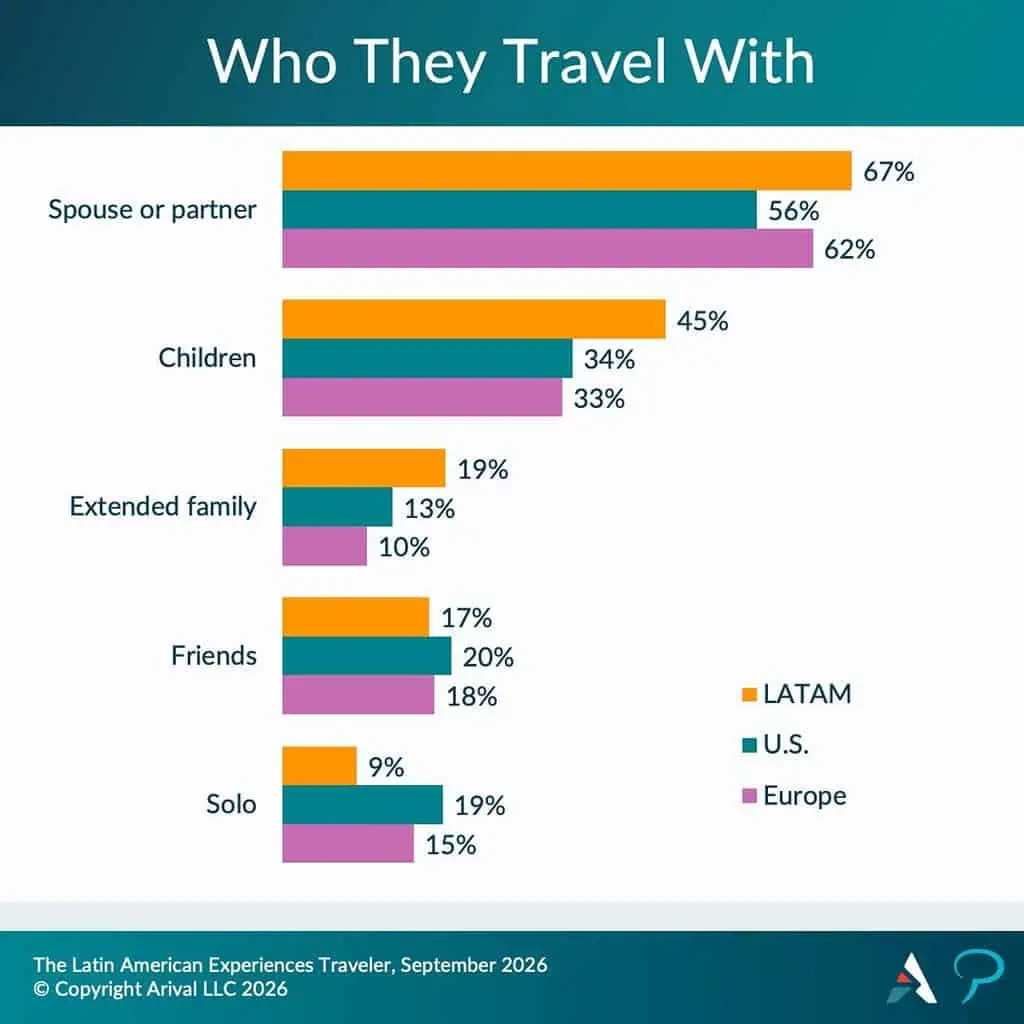
For operators, that means shared experiences beat individual adventures. Products built for multi-generational groups, and marketing that shows a family enjoying something together rather than one traveler having a personal breakthrough, will land better than the transformative-solo-journey positioning that works elsewhere.
12-15 Oct 2026 Insider Pro Access Members Save 20% THE event of the year for creators and sellers of destination experiences to connect, learn & grow. Don’t Miss Out! Get Your Ticket Today!
3. The Classics Still Win
Forget the hidden gems — LATAM travelers want the postcards. Sightseeing tours, cultural sites and landmarks top experience participation across all three countries surveyed and every age group. Nearly all LATAM travelers (96%) visit at least one attraction on their trip, and most take at least one tour (87%) or activity (77%). Immersive, local-host and niche products remain a distant secondary interest, even among travelers under 35, who elsewhere have been the demographic most drawn to alternative, off-the-beaten-path experiences.
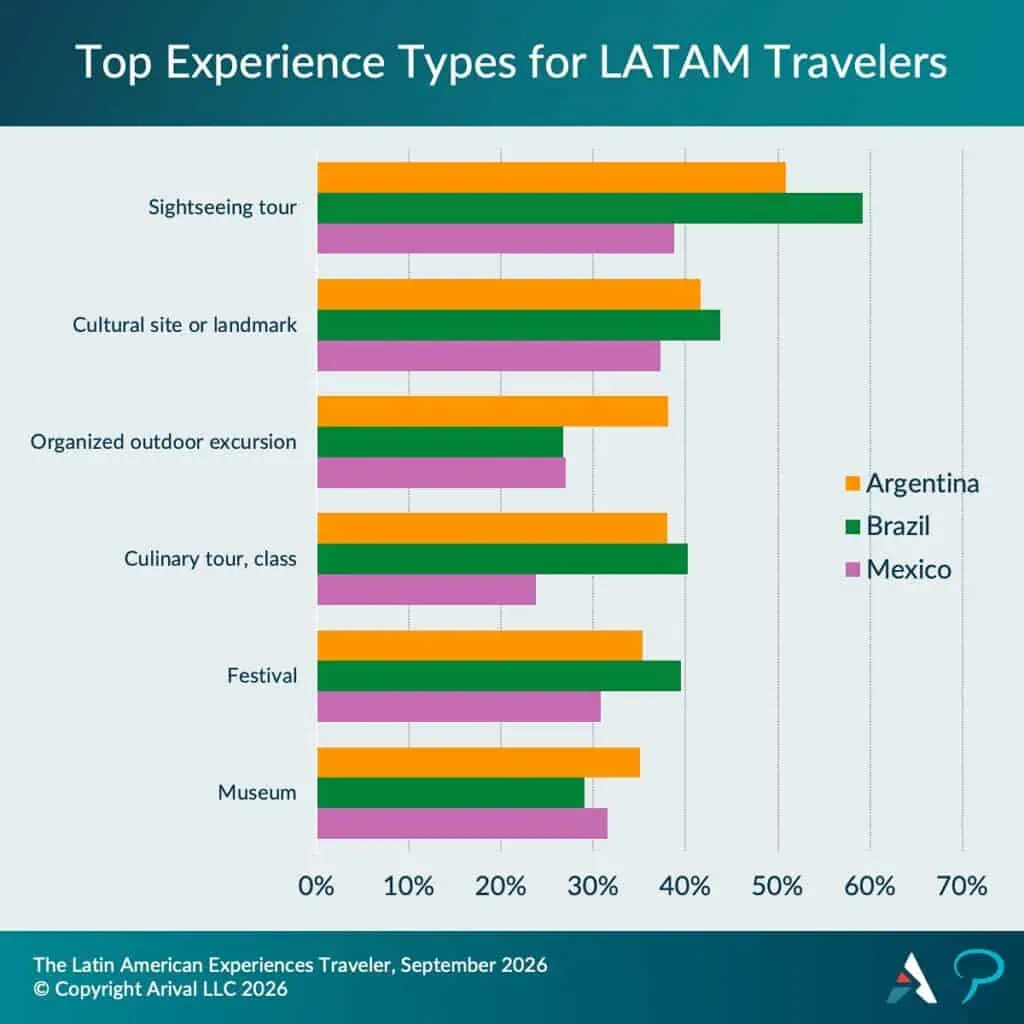
This preference for classic sightseeing ties this directly back to trip frequency: when a family only travels once or twice a year, checking off the must-see landmark matters more than discovering something “undiscovered.”
For operators, this is a reason to lead with the classics. Sightseeing, cultural attractions and iconic landmarks are the commercial backbone of the market; niche and immersive products work best as an add-on to that portfolio, not a replacement for it.
4. Longer Stays, Tighter Budgets
When LATAM travelers do take their big trip, they stretch it. Argentine travelers average nine nights per trip and Brazilians average eight — longer than U.S., U.K. or Spanish travelers, and on par with French travelers. Yet total trip spend remains lower across the board: the average trip costs $1,512 in Argentina, $2,699 in Brazil and $2,432 in Mexico, compared with $3,819 in the U.S. and more than $3,300 in the U.K. and Germany.
For operators, longer stays create more days, and more opportunities to sell tours and attractions during a single trip. But converting on price sensitivity takes more than a discount: bundles, inclusive pricing and clearly-communicated value are likely to outperform blanket promotions.
Operator Takeaway: Design for the Big Trip, Not the Frequent Flyer
LATAM travelers aren’t booking often, but when they do, every bit of the trip counts. Operators who win in this market will:
- Build packages for families and multi-generational groups, and tailor marketing for them
- Lead with iconic, must-see products rather than attempting to stand out with niche offerings
- Price around value, such as bundles and inclusive packages, rather than one-off discounts
- Use a longer average stay as a chance to sell more than one experience per trip
Learn More with the Full Report & Webinar
These findings only scratches the surface of what’s covered in the full report. The Latin American Experiences Traveler, produced by Arival and Phocuswright in partnership with Civitatis, also covers how LATAM travelers use AI in trip planning (70% already have), which channels they trust most when booking experiences, how upgrade and upsell behavior differs by market and age, and eight strategic keys for building a successful LATAM strategy.
Download the full report to learn more — available at no cost to Arival Insider Free and Pro members – simply sign up for a free membership or log on to get your copy.
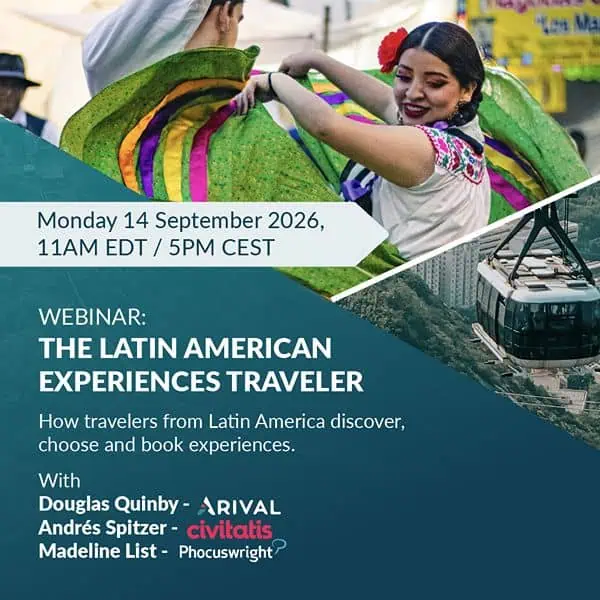
Also, join us for a special webinar on 14 September 2026, where Arival’s Douglas Quinby and Civitatis CEO Andres Spitzer will dive into the findings and discuss what they mean for operators, destinations, travel resellers, and the global experiences industry.

What’s Next? Dig Deeper with Arival
Join us at the next Arival event to get the latest insights from the top leaders in the experiences industry on the latest trends, research findings, technology, distribution and digital marketing strategies for tours, activities and attractions.
Become an Insider Pro Access member today and get access to the full library of Arival research, plus many other benefits such as free consulting sessions, special discounts and 20% off in-person events, starting from $179 per year.
Sign up to receive insights tailored for the in-destination industry as well as updates on Arival.
Header photo: Pexels / Omar Zetina