



If you’ve ever wondered why some operators dominate search results while others with equally strong experiences barely get noticed, reviews are almost certainly a big part of the answer.
Learning how to get more positive reviews for your experiences is one of the highest-leverage moves available to you. Far beyond simple vanity metrics, reviews now function as infrastructure. They influence where your experiences appear on booking platforms, how you rank in SEO results, how AI-powered search tools describe your business and — increasingly — whether a traveler ever finds you at all.
Many operators leave a large number of reviews on the table simply because they have never built a consistent system to capture them. This article covers why reviews matter more than ever in the current search landscape, how to measure where you stand, and the practical steps you can take to start generating more of them today.
Why Reviews Matter in the Age of AI Search and Discovery
Google’s AI Overviews, ChatGPT, Perplexity and a growing wave of AI-powered travel tools are changing how travelers find experiences. Rather than returning a list of links, these tools synthesize information from across the web and surface recommendations based on what they have learned is trusted and genuinely popular. Reviews are among the most powerful inputs feeding those recommendations.
When an AI tool is asked “what’s the best food tour in Lisbon,” it does not simply scan star ratings. It reads review language, identifies themes and weighs the volume and recency of feedback to judge what is genuinely well regarded. An experience with 12 reviews from two years ago is not competing on the same footing as one with 120 reviews from the past six months, particularly when those reviews are still arriving regularly.
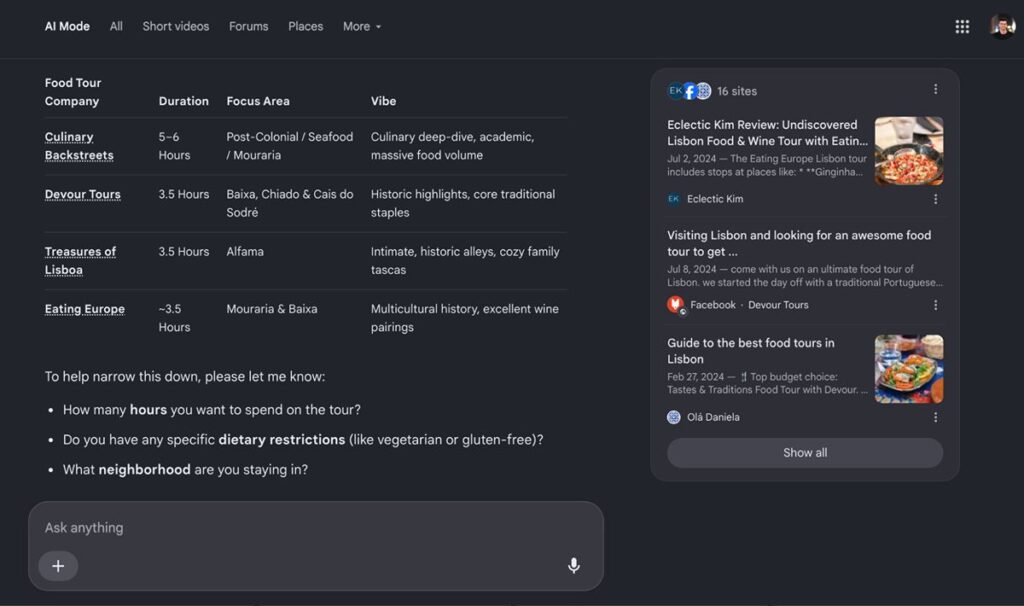
This shift is fundamental. The organic search optimization tactics operators relied on a decade ago, keyword-rich descriptions, backlinks and clean website structure — still matter. But reviews have become a parallel currency of credibility as AI tools take on a larger role in travel discovery. Recent Arival research found two in three travelers used AI to plan their trips, with affluent travelers in particular (four in five) relying on AI to research things to do. As more travelers lean on these tools to narrow their options, the volume, quality and recency of third-party information about an experience will weigh more heavily in whether it gets surfaced and recommended.
Operator Takeaway: Search the name of your experience in Google, ChatGPT and Perplexity right now, and note how each one describes your business and which signals it appears to draw on. If your reviews are thin or dated, that is where AI-driven discovery is working against you. Treat your review profile as a core part of your search strategy, not an afterthought.
12-15 Oct 2026 Insider Pro Access Members Save 20% THE event of the year for creators and sellers of destination experiences to connect, learn & grow. Don’t Miss Out! Get Your Ticket Today!
How to Start Tracking Your Review Rate Today
Before you can improve your review volume, you need to know where you stand. Your review rate — the percentage of paying customers who leave a review — is the single most useful metric for understanding how much value you are pulling from your existing customer base. It also underpins your online travel agency (OTA) positioning (more on that below) and your search relevancy.
There is no single industry-wide benchmark for tour, activity and attraction review rates. Performance varies widely depending on the type of experience, group size, customer demographic, booking channel and whether the operator has a structured process for requesting reviews. The most useful starting point is your own baseline.
If you have never calculated your baseline, the formula is simple: divide the number of reviews received over a period by the number of completed bookings or eligible customers during the same period, then multiply by 100.
Try it yourself here:
How to Calculate Your Review Rate
(%)
Use the same window for both numbers — e.g. the last 90 days
Once you have a baseline, you can see where reviews are slipping through the cracks. Are they dropping off with a particular guide? Are they higher for one product than another? Tracking review rate at the product or guide level surfaces operational strengths and weaknesses that an aggregate number hides.
This habit also gives you something to manage toward. Without a baseline, “more reviews” stays a vague aspiration. With one, it becomes a quarterly goal with a clear measure of success.
Operator Takeaway: Pull your booking data and review counts for the past 90 days and calculate your review rate this week. Set a target, improving from 8 percent to 12 percent represents a 50 percent increase in review volume without a single extra booking. Track the number monthly and share it with your team so review generation becomes a shared business metric rather than a guide-level afterthought.
The Importance of Frequent Reviews for OTA Algorithms
If your business appears on online travel agencies such as Viator, GetYourGuide or Tripadvisor, review recency is more than a nice-to-have. It directly affects where you appear in search results on those platforms. OTA ranking algorithms are not static; they continuously weigh signals that include booking conversion rates, response times and, critically, how recently and how often new reviews arrive.
The platforms say so themselves:
- Viator’s operator ranking guidance lists reviews and ratings among its core ranking factors and notes that the recency of reviews is part of the calculation.
- GetYourGuide is more explicit still, stating in its supply partner help center that customer reviews play a pivotal role in ranking and that recent reviews count more toward an activity’s overall rating.
- Tripadvisor’s Popularity Ranking works the same way: it weighs the quality, quantity and recency of reviews, and the company states plainly that recent reviews carry more weight because they better reflect the current experience.
- Airbnb spells it out in its guidance on how search results work: ratings and reviews from guests are a core quality factor in its ranking algorithm, and “higher quality listings with better ratings and reviews tend to rank higher in search.”

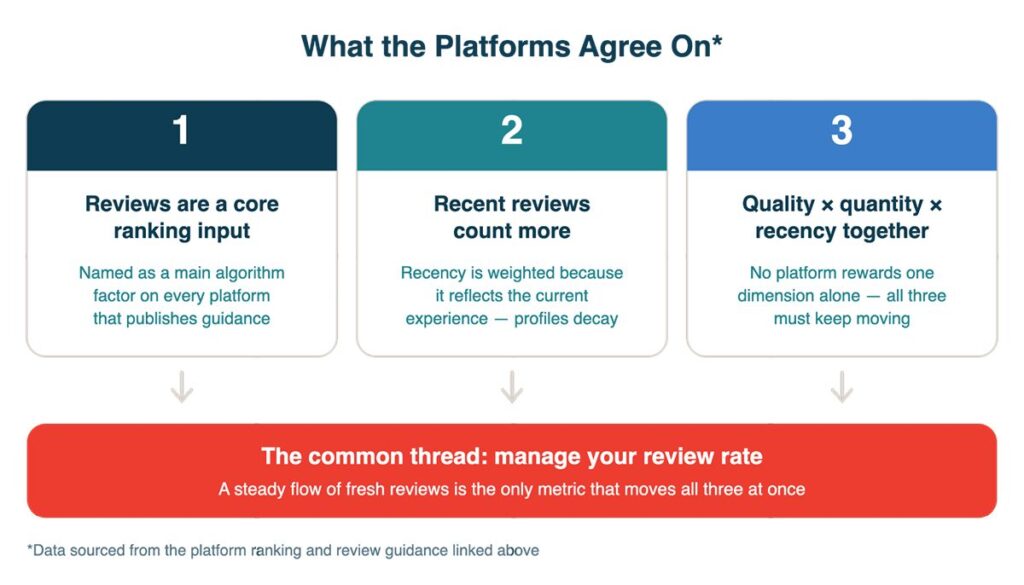
A tour, activity or attraction operator that was collecting reviews steadily a year ago but has gone quiet since will gradually lose ground to competitors generating fresh feedback every week. The platforms have a commercial incentive to surface active, engaged operators, because those experiences tend to convert better and produce fewer complaints.
This is why review acquisition works best as an ongoing operational habit rather than a one-time push. Seasonal operators in particular should be deliberate about generating a burst of reviews at the start of each season to reset their algorithmic standing before peak demand arrives. A quieter shoulder season is a chance to bank reviews for the months that matter most.
Operator Takeaway: Check the last review date on your three best-selling experiences today. If any have gone more than a few weeks without a new review, prioritize capturing one immediately. For seasonal operations, build a review re-activation campaign into your pre-season checklist every year and treat it as seriously as updating your pricing or refreshing your photos.
Train Your Team: The Fastest Way to Get More Tour Reviews
The most common reason operators miss out on reviews is simple: nobody asked. A direct request is consistently one of the highest-leverage actions a guide or host can take, and it costs nothing. Yet without deliberate training, most guides either never ask or ask in a way too vague to prompt action.
An effective review request has three qualities. It is personal, it is specific and it ends with a clear next step. Compare “please leave us a review if you can” with something like: “If you enjoyed today, it would mean a lot if you left us a quick review on Google or Tripadvisor. It helps other travelers find us and supports our small team.” The second version does the work the first one leaves to chance.
Training your guides on this does not need to be an elaborate process. A one-page brief covering when to ask — toward the end of the experience, not at the departure point — what to say and which platforms to direct guests to is enough to create consistency across your team. Role-playing the ask in team briefings makes it feel natural rather than awkward, and your strongest guides can coach newer ones using their own examples.
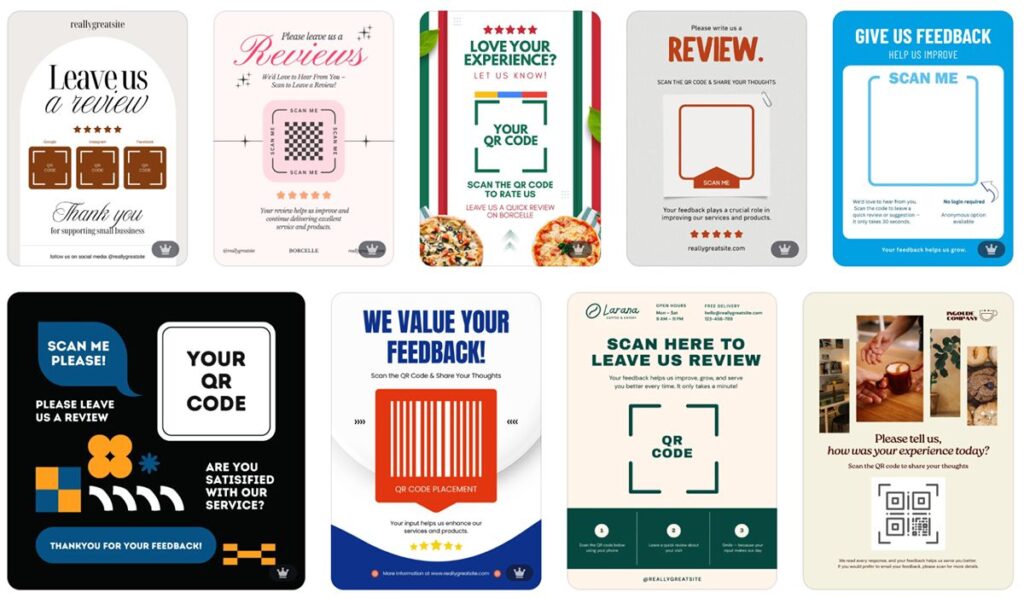
Some operators go further and hand guests a printed or digital card with a QR code at the end of the tour, explaining how to leave a review, where to find the link and why it matters. This removes friction at the moment motivation is highest, before the guest has moved on and the experience has started to fade.
A practical tip: ask the guide with your highest review rate to record a short video walking the rest of the team through how they do it, if they are willing.
Operator Takeaway: Write a one-page review request guide for your team this month. Include the exact words to use, the timing, the platforms to mention and how to handle a guest who raises a concern before the tour ends. Test it with your guides in a briefing before the next peak period and refine it around what feels natural for your brand.
13-15 April 2027 Insider Pro Access Members Save 20% THE event of the year for the European in-destination experiences industry Save up to €850 with an Autumn Advantage Ticket as an Insider Pro Member!
Use Linktree or a Purpose-Built Landing Page to Simplify the Ask
Even a motivated guest abandons the review process when the path is too complicated. Every extra click, login prompt or search step is a chance for friction to win, and most guests will not push through it. Reducing that friction is one of the most underused tactics available to operators who want more reviews.
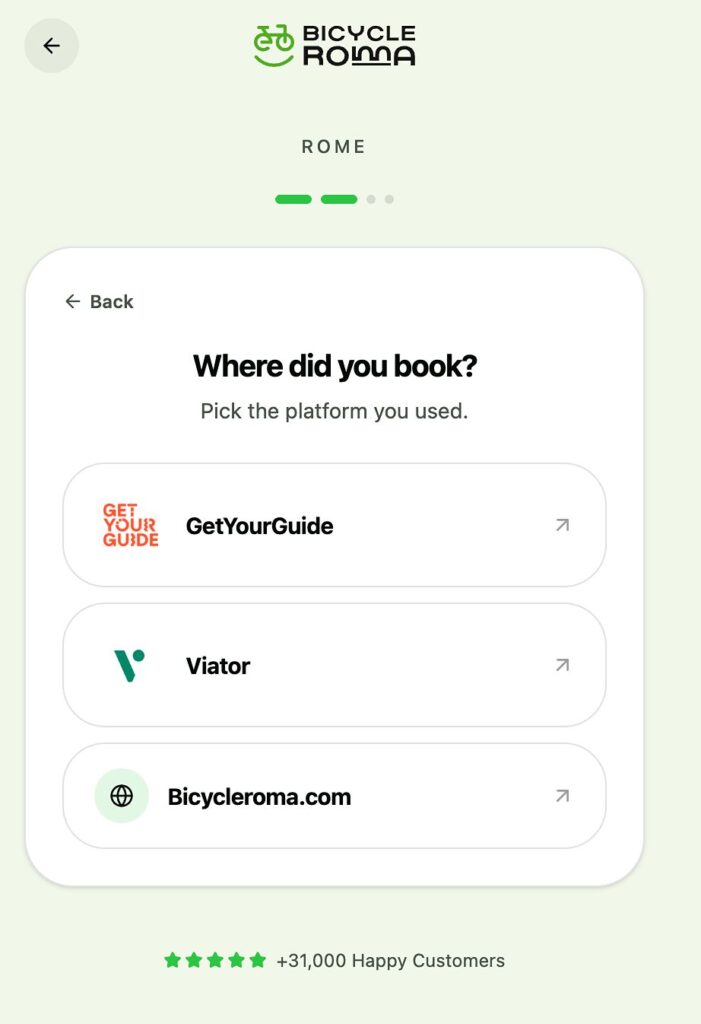
A Linktree page, or a simple custom landing page on your own website, consolidates every review link into one mobile-friendly destination. The guide closes the tour with a single instruction: “Scan this QR code to leave us a review, it takes less than a minute.” The guest lands on a clean page with clear buttons for Google, Tripadvisor, Viator and any other platform that matters to you. No searching, no confusion about where to go.
Purpose-built review pages go a step further. Tools like TourReview, or a page built on Webflow or Squarespace, can route guests by booking source so a Viator customer sees the Viator button first, and can surface a short prompt to remind the guest what to mention. If you offer a private feedback option, present it alongside the public review buttons rather than in place of them. Steering only satisfied guests toward public platforms while diverting unhappy ones to a private form is a practice known as review gating, and it violates the policies of both Google and Tripadvisor and can trigger ranking penalties or review removal.
Operators comfortable with AI tools can also build one themselves in an afternoon. Arival’s guide to vibe coding for tour operators includes a ready-made prompt for a Linktree-style guest hub.
QR codes at the right touchpoints make that page reachable without a word being spoken — on guide lanyards, branded thank-you cards, bus windows, feedback slips or post-experience emails. This matters most for larger group tours, where a personal ask to every guest is not practical and the window to capture attention closes fast.
Operator Takeaway: Set up a review landing page or Linktree this week with links to your three most important review platforms. Generate a QR code pointing to it with a free tool, print it on a small card and have your guides hand it out at the end of every departure. Track review volume over the following 30 days to measure the impact before rolling the approach out across all your products.
Review General Tips
Beyond generating volume, a handful of habits determine how much value each review actually delivers. Three stand out.
- Prioritize Google reviews. Not all review platforms pull equal weight, so order your ask deliberately. For most operators, Google should come first. Reviews on your Google Business Profile feed local search rankings directly, Google’s own local ranking guidance confirms that review count and score factor into where a business appears, and that same profile is a primary source AI tools draw on when describing and recommending your business. OTA reviews strengthen your placement within each marketplace; Google reviews strengthen how you surface everywhere else. Put the Google button first on your review landing page and make it the default platform in your team’s closing script.
- Encourage guests to name the tour. Review text is exactly what search engines and AI tools read when matching your experience to a traveler’s query, so “The Jack the Ripper Tour was great” does more for your visibility than “great tour.” A light suggestion is enough “if you mention the tour name, it really helps other travelers find us” and stops well short of scripting the review, which platforms prohibit.
- Respond to every review, and let AI draft the first pass. Google explicitly recommends responding to reviews in the same ranking guidance, and on OTAs a listing where the operator visibly engages with feedback reads as active and well managed, to the algorithm and to the traveler scrolling past it. Responses are also content: every reply becomes part of the public text on your listing, read by future guests and by AI tools deciding how to describe you. Pro tip: A thoughtful response to a critical review often does more for conversion than another five-star rating.
The workload objection used to be fair, and this is where AI earns its keep. Tools like ChatGPT or Claude can draft responses in your brand voice in seconds, and can be given standing instructions: thank the guest by name, reference something specific from their review, keep it under 80 words. Two rules keep the approach safe — a human reads every draft before it posts, and negative reviews always get personal attention, because an obviously templated reply under a complaint compounds the damage. Wondering what to do about negative reviews? Here’s some tips on how to respond to negative reviews effectively.
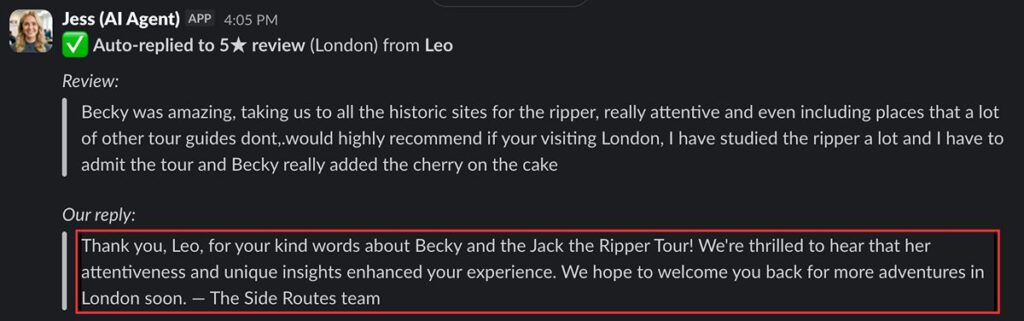
Operator Takeaway: Take these three steps this month: reorder your landing page with Google first, add the product-name suggestion to your guides’ closing script, and clear your response backlog with AI-drafted replies you edit before posting. Then hold a 48-hour response standard, owned by one named person so it survives the busy season.
It’s Time to Review your Review Strategy
Reviews have always mattered to tour operators. What has changed is how far their influence now reaches: the same review profile feeds OTA ranking algorithms and the AI tools millions of travelers now use to decide where to book. Operators who manage review generation as a measurable part of the business hold a structural advantage over those who leave it to chance.
The playbook is simple, actionable, and within reach for any operator:
- Calculate your review rate so you know where you stand.
- Train guides to make the review ask with every group.
- Give guests one frictionless place to land — a QR code pointing at a simple review page covers it.
The main investment is the discipline to keep asking through the whole season, including the slow months.
Every tour, activity and attraction company offers experiences their guests would happily vouch for. What’s usually missing is the review ask at the end. Start with your next experience: brief the guide on the closing script and count the reviews that come back.
Finally, once you have those reviews coming in, not only will you be actively improving your AI visibility and OTA search rankings — you’ll be armed with recent, valuable data about your products from your customers. Analyzing those reviews and using that data to improve your products is an important next step — learn more here on how AI can help with that process.
Oliver Green is an Arival Insights Contributor and regular speaker at Arival events. As a travel and tourism consultant and operator, he specializes in automation, AI, and scalable systems for tour companies. He helps operators increase direct revenue, reduce operational overhead and modernize their tech stack.
About the Author

Oliver Green is an Arival Insights Contributor and regular speaker at Arival events. As a travel and tourism consultant and operator, he specializes in automation, AI, and scalable systems for tour companies. He helps operators increase direct revenue, reduce operational overhead and modernize their tech stack.
Become an Insider Pro Access member today and get access to the full library of Arival research, plus many other benefits such as free consulting sessions, special discounts and 20% off in-person events, starting from $179 per year.
Sign up to receive insights tailored for the in-destination industry as well as updates on Arival.
Header photo: Created using Generative AI