



Travelers are no longer starting their trips on a search results page. They are starting them in a conversation. They ask a chatbot where to go, what to do and what is worth booking, and they arrive at your listing already half-decided.
That single shift in behavior is the throughline of AI That Works, the Spring 2026 Travel Experience Trend Tracker produced by GetYourGuide and built on the findings of Arival’s Global Operator Landscape (4th Edition) study. The report explores the current state of AI usage in the experiences sector to answer the question most operators are actually asking: not whether AI matters, but what to do with it on Monday morning. It pairs industry data with a level-by-level playbook for putting AI to work across the business.
We’re sharing some highlights from the report below, along with what each one means for the way you run your business.
Dig deeper with the full report: AI That Works is available as a free download from GetYourGuide.

Travelers Are Discovering Experiences Through AI
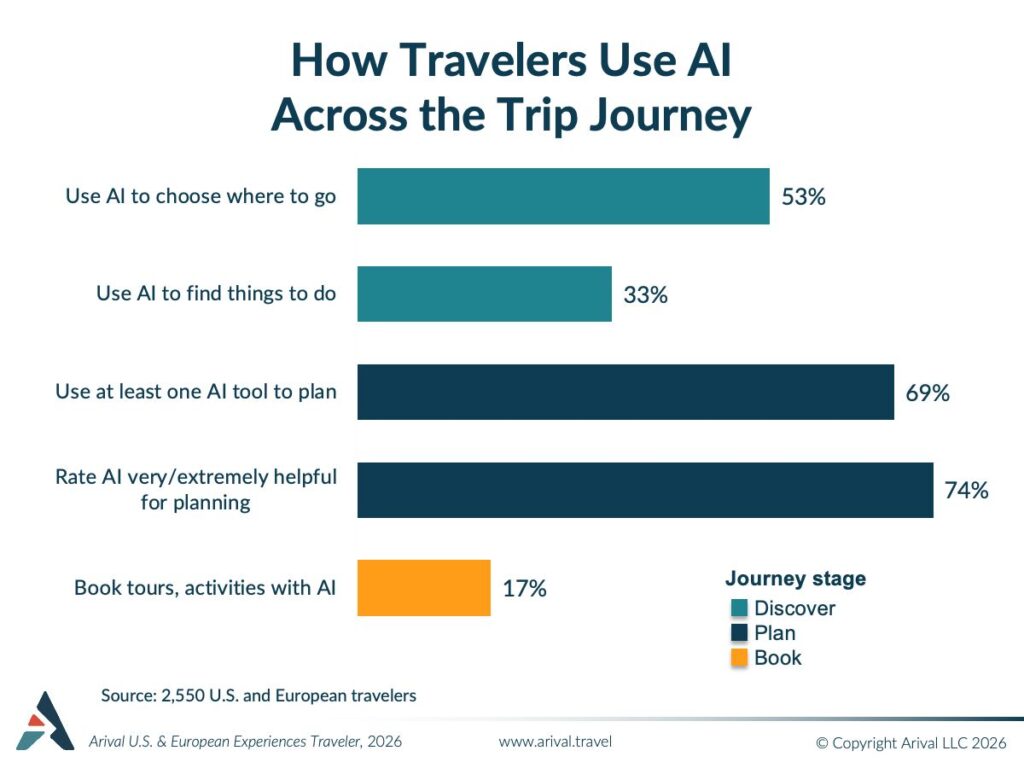
The clearest signal in the data is that AI has already moved upstream into the dream-and-plan phase of the traveler journey. According to Arival’s 2026 Experiences Traveler study, 53% of travelers use AI for destination research and 33% use it specifically to discover things to do.
This data also tracks with broader consumer behavior. Adobe Analytics reported in March 2025 that traffic to U.S. retail sites from generative AI sources jumped 1,200% in seven months, and Bain & Company found in early 2025 that roughly 68% of large language model (LLM) users rely on these platforms to research, gather and summarize information. The opportunity isn’t to compete with AI. It’s to be discovered by it.
Discovery Is Where the Biggest Change Is Happening
The traffic AI sends is not just larger, it is better. Travelers directed to travel sites via AI search arrive more informed and ready to book, with a 45% lower bounce rate than visitors from other sources, according to an Adobe Analytics Traffic report. That changes the math: a smaller pool of AI-referred visitors can convert at a meaningfully higher rate.
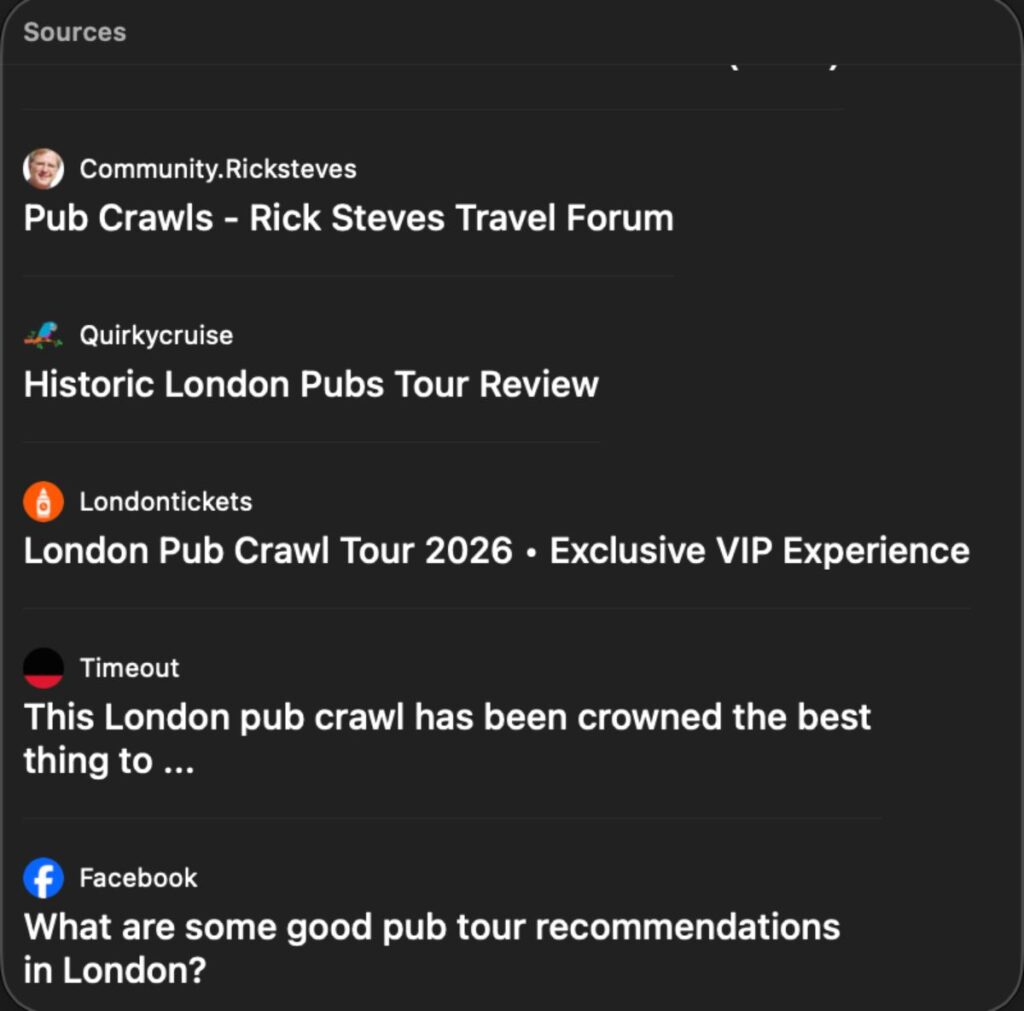
Getting found now depends on a discipline the report calls Answer Engine Optimization (AEO). Where traditional search engine optimization (SEO) is about ranking a page, AEO is about making your content easy for an answer engine to extract, trust and recommend. Complete, accurate, well-structured listings with clear inclusions, concise highlights, scannable FAQs and consistent timings are far more likely to be selected when a traveler asks an LLM what to do. Listings an AI cannot cleanly read simply will not be recommended.
This is not a niche concern for much longer. Semrush reported in July 2025 that AI search is on track to overtake traditional search for some topics by 2028, and that AI-search visitors can convert at several times the rate of traditional organic visitors.
Where Operators Stand Today
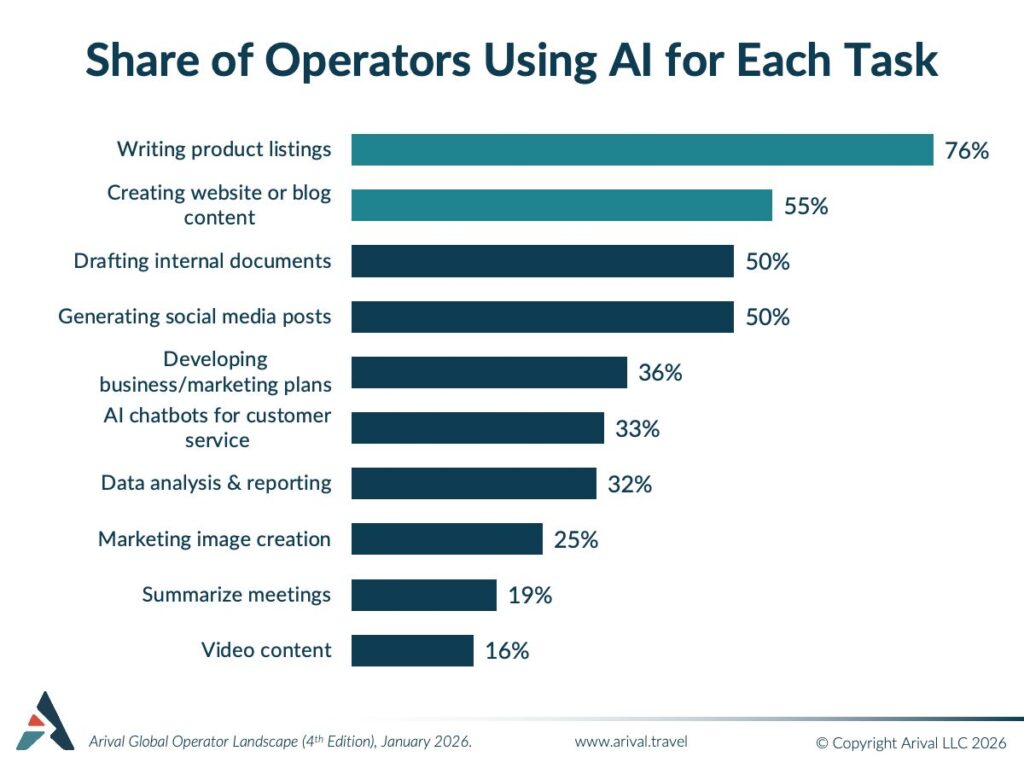
Most operators have at least experimented. Content creation is the runaway leading use case: 76% of operators already use AI to write product listings, well ahead of website and blog content (55%) and internal documents and social posts (both around 50%). Everything else, from chatbots to data analysis to image creation, is still climbing.
The more striking pattern is who is pulling ahead. The most profitable operators, those with margins above 20%, are roughly 25% more likely to be using AI than non-profitable ones, and they report getting more out of it. Half of profitable operators call AI very effective, compared with 38% of those who are not profitable. The advantage is less about using AI and more about using it well.
The momentum is broad-based. GetYourGuide’s own March 2026 supplier research found 64% of operators are using AI more than they did a year ago, with adoption rising across every business size, from small operators to enterprises.
12-15 Oct 2026 Insider Pro Access Members Save 20% THE event of the year for creators and sellers of destination experiences to connect, learn & grow. Don’t Miss Out! Get Your Ticket Today!
The Playbook: Start, Build, Scale
The heart of the report is a playbook organized around three business pillars, each with three levels so you can enter from wherever you are.
Content and marketing is about making your listings work harder. At the “Start” level you refresh what you already have, rewriting your top listing or generating email subject lines. At “Build” you create a one-page brand voice guide and paste it into every prompt so output sounds like you. At “Scale” you optimize explicitly for AI search and localize your best listings into multiple languages with a native-speaker check.
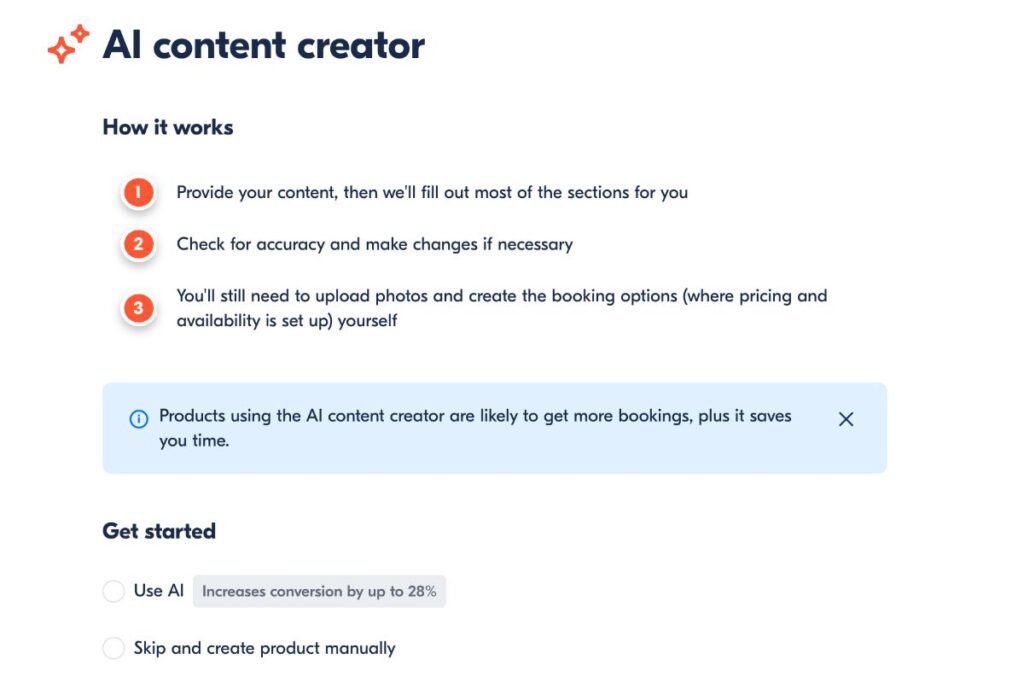
Operations is about taking admin off your plate. Start by turning your five most common guest questions into polished, reusable templates. Build by drafting onboarding documents and standard operating procedures. Scale by using AI to analyze booking patterns and flag bottlenecks. Results here are strong: about 78% of operators using AI in operations see a positive impact on business planning and analysis.
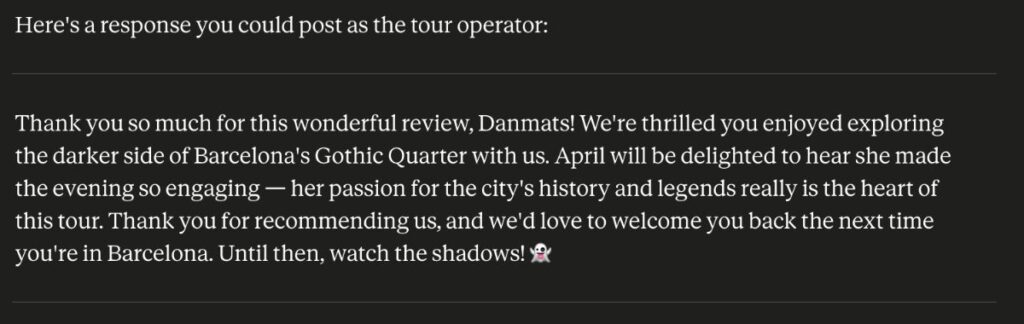
Feedback and reviews may be the most underused asset of the three. Products with 15 or more reviews earn roughly 10 times the bookings of those with none. Start by drafting replies to unanswered reviews. Build by exporting 20 to 50 reviews and asking an AI model/LLM to surface the top five recurring themes. Scale by feeding your guests’ own positive language back into your marketing, because real guest words sell better than anything a writer or an AI can invent.
Tip: Create a customGPT or Claude Skill trained on your brand voice to generate replies to reviews.
Where Operators Trip Up
Most AI missteps are not technical. Common failure points include vague prompts, blind trust in output, poor data quality, skipping change management and starting without a clear goal. The risk of blind trust is concrete: 44% of operators say they have been given inaccurate or misleading information by AI. The fix is human oversight. Use AI to create drafts, but ensure a person signs off before anything reaches a guest, a listing or a booking.
The deeper differentiator is mindset. The report contrasts the experimenter, who tries AI when there is time and judges it on early results, with the leader, who builds AI into regular workflows, connects it across the business and iterates over time.
As Janette Roush, Chief AI Officer of Brand USA, puts it: ““Most of us use AI. Few of us work inside of it. That’s the shift. The operators who turn occasional use into daily practice – who build AI into how they brief their teams, write their listings, respond to guests, and learn from reviews – will compound advantages that are very hard to replicate.”
Tip: Isolate workflows to projects/skills, build guardrails to minimize mistake, always proof read and cross reference.
What This Means for Operators
The message of the AI That Works report is reassuring and urgent at once. AI is not booking your tours out from under you, but it is increasingly deciding which experiences get surfaced when a traveler asks for ideas. Here is where to focus.
- Test your AI visibility first. Before you touch pricing or photos, ask ChatGPT, Gemini and Claude what to do in your destination and see whether you appear. That answer tells you how much work your discovery layer needs.
- Rebuild your best listing for machines. Take your top seller and make it machine-readable: lead with a specific category and location, add a structured highlights list, spell out what is and is not included, and add a short question-and-answer FAQ. Treat AEO as an extension of SEO, not a replacement.
- Go beyond content. If listings are your only AI use case, you are leaving value on the table. Pick one operations or reviews task this quarter and measure the time it saves. Profitability correlates with breadth and skill, not novelty.
- Pick one pillar, not three. Choose the area where you lose the most time, commit to one Start-level action this week, and only move up once it is a habit. A realistic 30-day goal beats a sweeping plan you abandon.
- Keep a human in the loop. Add a lightweight “AI draft, human edit” step to every workflow and appoint one or two AI champions to maintain shared prompts and templates. Human oversight plus consistent team practice is what turns scattered experimentation into compounding returns.
The Bottom Line
Stacking up tools isn’t what separates the operators who get ahead. What matters is treating AI discovery as a real channel, building a few disciplined habits around content, operations and reviews, and keeping a human hand on everything a guest sees.
Dig deeper with the full report: AI That Works is available as a free download from GetYourGuide.
About the Author

Oliver Green is an Arival Insights Contributor and regular speaker at Arival events. As a travel and tourism consultant and operator, he specializes in automation, AI, and scalable systems for tour companies. He helps operators increase direct revenue, reduce operational overhead and modernize their tech stack.
Learn More with Arival
Get the full Arival experience by joining us at an upcoming Arival event, and hear the latest research insights and tips on AI and digital marketing for the experiences sector directly from tours, activities and attractions industry leaders and experts, including Oliver Green!
Become an Insider Pro Access member today and get access to the full library of Arival research, plus many other benefits such as free consulting sessions, special discounts and 20% off in-person events, starting from $179 per year.
Sign up to receive insights tailored for the in-destination industry as well as updates on Arival.