

There are many types of tours – and many types of travelers. But what do travelers actually want from a tour in 2026? What is driving traveler choice? And how should operators be designing and positioning their products?
Based on Arival’s latest consumer research across U.S. and European travelers, the answer is surprisingly clear. While the market is fragmented, traveler expectations around tours are not. A few consistent themes emerge, and they have direct implications for how tours should be built and sold.
Shorter, Not Smaller Experiences
Perhaps the most important theme is duration. More than 70% of tours are under three hours. Shorter tours are not a niche, they are the core of the market. But they may not be the core of the trip, or even of the day of the trip.
The dominance of shorter tours indicates they are one of several experiences travelers fit into a packed itinerary. Travelers want digestible, time-efficient experiences that slot easily into their plans. This elevates the importance of scheduling and availability. Flexible time slots, frequent departures and easy booking windows are essential.
Longer tours — such as half-day or full-day city experiences and excursions — still play a very important role, especially for more sun and beach and outdoor destinations with more active experiences.
12-15 Oct 2026 Insider Pro Access Members Save 20% THE event of the year for creators and sellers of destination experiences to connect, learn & grow. It’s Your Last Call to Save! Get Your Ticket Today!
Hit the Checklist, with Ease
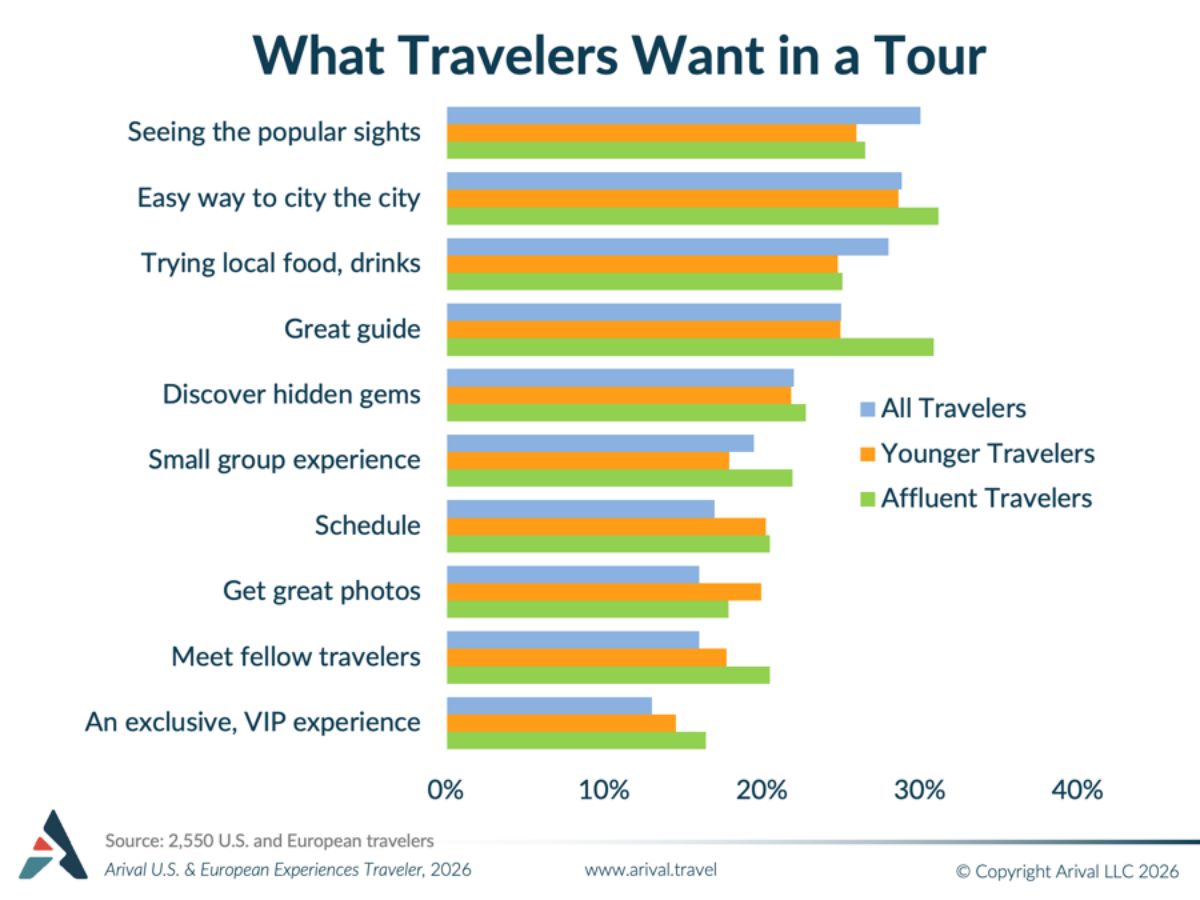
Sightseeing still sits at the core of tour demand. Travelers want to see the highlights, the landmarks, the “must-do” experiences. But how they want to do it has evolved.
Across markets, travelers consistently prioritize:
- Seeing the popular sights
- An easy way to explore the city
- A great guide
- Trying local food and drink
The modern tour is not just about access, sightseeing or storytelling (although those things are very important). It is also about reducing friction. This is particularly pronounced among older travelers. Boomers and seniors, the 55+ segment, are also seeking convenience and reassurance. They want to know everything is well organized and stress-free. Younger travelers, by contrast, are more open to spontaneity and discovery.
The implication is straightforward: the best tours don’t just enable you to experience something amazing. They also make it easy to experience.
Human Guides Matter
Despite the incredible rise of AI and amazing information access at every traveler’s fingertips, the guide – that human touch – remains essential. It still defines the experience. Having a “great guide” ranks among the top decision drivers across all segments — and even more so among affluent travelers.
For higher-value customers, the guide is not just part of the experience; they are the experience. Travelers are willing to pay more for smaller groups or private tours, but in return they expect exceptional delivery, personality, and expertise.
Technology may reshape how tours are discovered and booked. But what determines reviews, ratings, and repeat business is still execution on the ground.
Small Groups, Big Expectations
Travelers continue to favor small group experiences, reinforcing the broader shift toward more personal, higher-quality tours. This preference is less about luxury and more about ease, intimacy and experience quality. Guests want to be able to hear, participate, and engage directly with the guide.
At the same time, explicitly “VIP” or exclusive positioning ranks lower than practical benefits. Travelers don’t necessarily need something labeled premium; they want something that feels better, smoother, and more personal.
Join us at an upcoming Arival event to connect, learn, & grow your tours, activities, & attractions business
The Real Story: Know Thy Customer
While these core preferences are consistent, the real story is in how different traveler segments interpret them, and what that means for operators.
Younger Travelers: Make It Social, Make It Shareable
Younger travelers are not just looking to see — they’re looking to experience and share. They over-index on:
- Getting great photos
- Meeting other travelers
- Social, participatory moments
For this segment, the tour is part experience, part content, part social engagement. Operators targeting younger travelers should design tours that are:
- Visually compelling (photo moments built in, not incidental)
- Social by design (interaction, group energy, shared moments)
- Experiential (food, local culture, hands-on elements)
Positioning matters just as much as product here. This is less about “guided tours” and more about “experiences you’ll share and remember.”
Affluent Travelers: Quality, Access, and Execution
Affluent travelers are driving a disproportionate share of demand, especially for U.S. travel to Europe, and they are far more demanding. They prioritize:
- The quality of the guide
- Ease and structure
- Premium touches (access, timing, service)
For this segment, the gap between a good tour and a great one is not what you see—it’s how it’s delivered. Operators should lean into:
- Smaller formats (small group or private)
- Top-tier guides (this is the product)
- Seamless execution (no friction, no uncertainty)
This is also where pricing power sits, with plenty of room to charge a premium. But that only works if the experience consistently delivers at a higher level.
U.S. vs. Europe: Same Fundamentals, Different Emphasis
The differences between U.S. and European travelers are not huge, but they are meaningful. U.S. travelers tend to lean slightly more toward variety and experiential elements: food, activities, and participatory experiences. European travelers skew more toward cultural sightseeing and learning.
This doesn’t mean operators need to develop entirely different products, but these differences could influence how operators should sell their tours.
- For U.S. travelers, lean into experience, variety, and energy
- In Europe, emphasize culture, context, and understanding
The product may be similar, but the messaging should be tailored to the traveler segment and market.
What This Means for Operators
There are a few fundamentals that apply to most operators. Today’s traveler wants shorter, easier, flexible, guided experiences. But that’s just the baseline.
The real opportunity (and this is the harder part) is aligning the right products and marketing to the right audiences. Different travelers want different things, and the gap between them is widening. The operators who understand that — and can build for it — are the ones pulling ahead.
Explore the latest Experiences Traveler research with Arival
Dig deeper into the latest research on U.S. and European experiences travelers – who they are, what they want, what they are looking for in 2026 – and some key trends shaping the tours, activities and attractions sector for the coming year with Arival’s 2026 U.S. Experiences Traveler Outlook and 2026 European Experiences Traveler Outlook reports. Available at no cost to Arival Insider Pro members.
Become an Insider Pro Access member today and get access to the full library of Arival research, plus many other benefits such as free consulting sessions, special discounts and 20% off in-person events, starting from $179 per year.
Sign up to receive insights tailored for the in-destination industry as well as updates on Arival.
Header photo: Pexels / Helena Jankovičová Kováčová