



If you are concerned – and confused – about the state of the traveler in 2026, you’re not alone. There are a lot of signals, and they’re increasingly contradictory.
In the U.S., economic indicators are sending conflicting messages: employment remains strong, inflation is rising, and consumer sentiment is weak. And yet travel demand, particularly among higher-income travelers, continues to hold. As Delta’s CEO recently noted, affluent travelers appear largely insulated from geopolitical shocks.
In Europe, the intent to travel is as strong as ever, according to the April 2026 European Traveler Sentiment tracking study from the European Travel Commission (ETC), although travelers are pulling back on trip length and spend, and staying closer to home.
Of course, the biggest threat looming over travel is the geo-political uncertainty, which seems only to be increasing. The war in the Middle East has added new volatility, pushing up fuel costs, increasing airfares and weighing on consumer confidence. Recent earnings announcements from Europe’s largest tour operator TUI indicate notable declines in summer bookings for the U.K. and Germany, as holidaymakers hold off on booking decisions.
This is the defining tension of the 2026 traveler: wanting to travel, but increasingly cautious about when, where and how.
What the research tells us: Decoding experience travelers in 2026
For the latest Arival research on The 2026 Experiences Traveler, we surveyed 2,550 U.S. and European travelers to get a better indication of key trends, behaviors, sentiment and trip intentions — and what this means for operators. Here are a few themes that stood out:
The pullback was already underway
Even before the war in the Middle East, travelers in the U.S. and Europe were already showing signs of hesitancy, pulling back on spend in 2025. After several years of robust post-pandemic growth, both U.S. and European travelers spent less on travel in 2025, according to Arival’s 2026 U.S. Experiences Traveler Outlook and 2026 European Experiences Traveler Outlook reports.
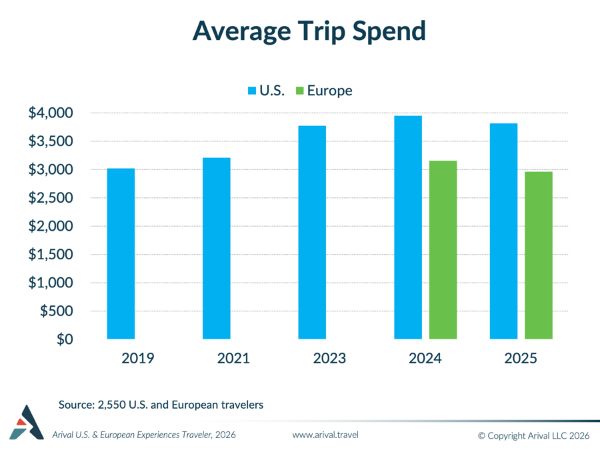
That same pattern shows up in traveler intent. We ask travelers at the end of 2025 about the travel plans for this year. More than four in five U.S. and European travelers said they planned to travel the same or less in 2026, with those planning to travel less outnumbering those planning to travel more.
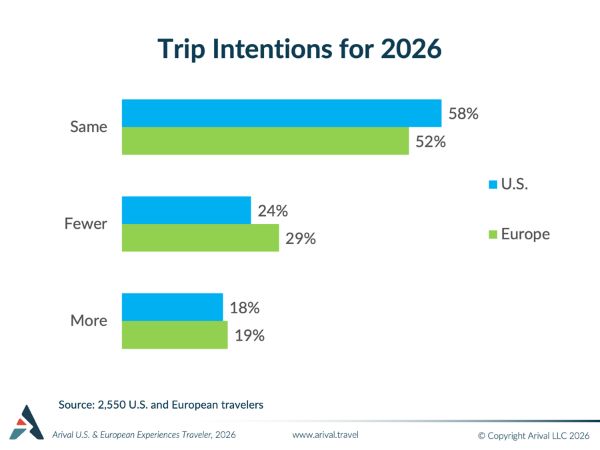
The only segment breaking from this pattern is affluent U.S. travelers (household income $150K+), where a greater share plan to travel more — though still just over one in five (22% vs. 18% for all U.S. travelers).
The key driver is not a loss of interest in travel. It is a loss of confidence: concern about personal finances, followed closely by broader geopolitical and economic uncertainty. Notably, this data predates the start of the Middle East conflict, suggesting sentiment has only deteriorated further since.
Europe: strong intent, cautious execution
In Europe, the picture is similarly nuanced.
Travel intent remains strong, with a growing share of Europeans planning trips in 2026, accordion . But behavior is shifting. Concerned about safety, geopolitical volatility and rising costs, travelers are taking shorter trips, staying closer to home and spending more conservatively, according to the ETC.
The result is a traveler who still prioritizes travel but is managing it more carefully.
Experiences may be the exception
Even as travelers pull back on overall trip spend, they continue to prioritize experiences. Participation is holding and in some cases growing. U.S. travelers took more tours and attractions per trip in 2025, while European travelers shifted slightly away from tours but maintained overall experience engagement through attractions.
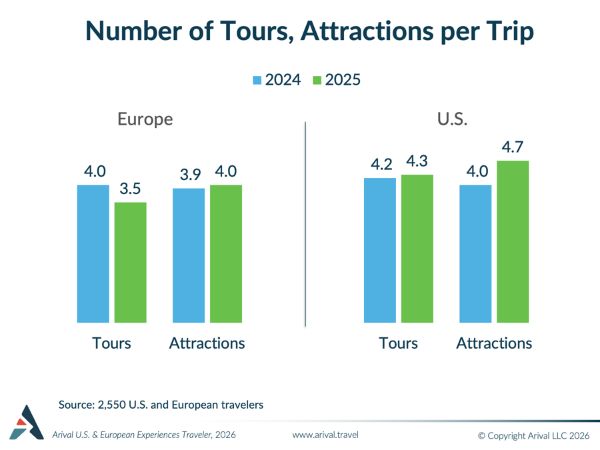
With overall trip spend down, this is a notable signal for the experiences sector: travelers still prioritize experiences, but they are reshaping how they engage with them.
A growing divide in spend
U.S. travelers, led by higher-income segments, increased their spend on tours and attractions in 2025. European travelers, by contrast, reduced spend across both categories, even as they continued to participate.
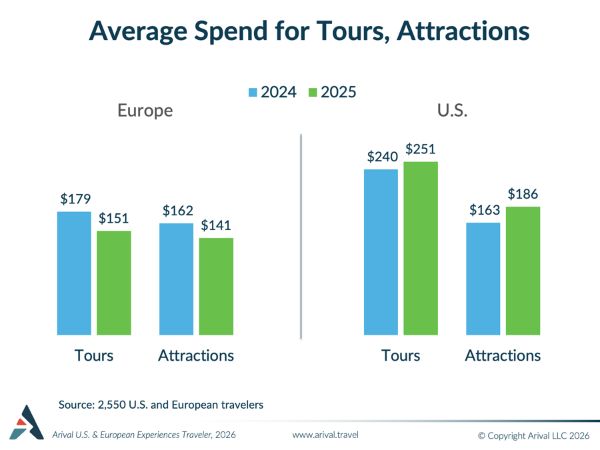
This divergence highlights a growing divide in the market. On one side: affluent travelers continuing to spend, upgrade and prioritize premium experiences. On the other: a more constrained traveler, still participating, but with a sharper focus on price and value.
12-15 Oct 2026 Insider Pro Access Members Save 20% THE event of the year for creators and sellers of destination experiences to connect, learn & grow. It’s Your Last Call to Save! Get Your Ticket Today!
What this means: Five things operators should do in 2026
The 2026 experiences traveler is not pulling back from travel, but they are recalibrating.
- They are still traveling, but with more hesitation.
- They are still booking experiences, but with more scrutiny.
- They are still spending, but increasingly unevenly across segments.
What should operators and sellers of experiences do for 2026?
- Double down on value clarity. Travelers are comparing more and questioning more. Make the value of your experience obvious and defensible.
- Build for two segments. The affluent traveler is driving growth; the mass market is under pressure. One-size-fits-all pricing and product won’t hold.
- Lean into experiences as the priority. Travelers may cut elsewhere, but experiences remain central to the trip.
- Offer flexibility and reduce friction. Hesitation means shorter booking windows and more second-guessing. Flexible policies and clear messaging matter more than ever.
- Focus on yield, not just volume. Growth is no longer just about more bookings, it’s about the right bookings at the right price. Smarter, strategic pricing is no longer leading edge – it’s a must-have.
This is the year where the travel business gets complicated. Agility will be critical. Operators who adapt to this more cautious, more segmented, and more selective traveler will be the ones to come out ahead.
Explore the latest Experiences Traveler research with Arival
Dig deeper into the latest research on the U.S. and European experiences travelers – who they are, what they want, what are they looking for in 2026 – and some key trends shaping the tours, activities and attractions sector for the coming year with Arival’s 2026 U.S. Experiences Traveler Outlook and 2026 European Experiences Traveler Outlook reports. Available at no cost to Arival Insider Pro members.
Also, join us to learn more in person in one or more of these upcoming online Arival events:


Become an Insider Pro Access member today and get access to the full library of Arival research, plus many other benefits such as free consulting sessions, special discounts and 20% off in-person events, starting from $179 per year.
Sign up to receive insights tailored for the in-destination industry as well as updates on Arival.
Header photo: Unsplash / Goh Rhy Yan