


If you feel like direct bookings are getting harder to come by, you’re not alone. With online travel agencies (OTAs) share of online bookings continuing to grow, and AI turning traditional search on its head, how can individual tour and activity operators stand out?
One often overlooked strategy is branding, according to Brian Nicholson, Partner at Blend Travel Marketing. And while some might suggest branding is dead in the age of AI, according to Nicholson, it’s exactly the opposite: it’s more important than ever to communicate what you’re all about and be precise about who your products are for. Branding is one of the key ways operators can take control of their online presence, and differentiate themselves in an increasingly competitive — and confusing — digital marketing landscape.
However, branding is also one of the most misunderstood practices. Here, Nicholson shares several common mistakes he sees operators make — and what they should be doing instead to build their brand, and attract more customers.
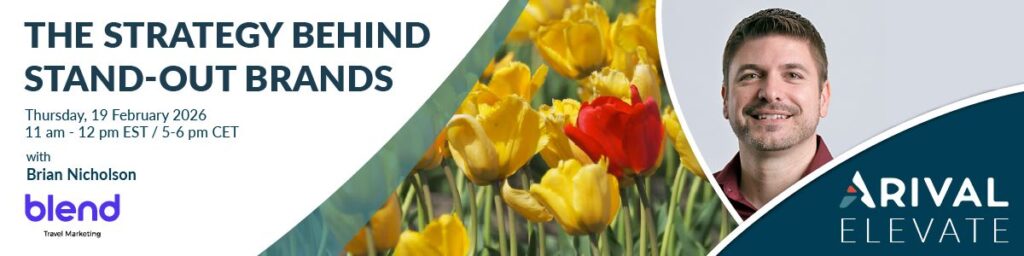
Editor’s note: This article is a preview of an upcoming Arival | Elevate session on brand strategy, led by Brian Nicholson. Find more details and register below:
What is Branding?
While many focus on logos, colors and websites when they think about branding, Nicholson is quick to point out that while these things can be an expression of your brand, brand is much more than that. “It’s about who you are,” he says.
“Brand is the impression that your company has created and retained in customer’s minds visually and verbally and experientially, and through word of mouth, like what it is that people think about you and understand about you.”
This can be broken down into two things:
- Brand Strategy: Who you are, how you differentiate in the market, who you’re the best for, etc.
- Brand Identity: The visual, verbal and experiential expression of your brand strategy.
“That’s it in a really small nutshell,” says Nicholson. “ Really understanding who you are and then making sure that you articulate that correctly.”
Is Branding Still Important for Tour Operators in the Age of AI?
AI may be changing the search game, but that doesn’t make branding any less important — if anything, it’s more important now than ever to make it clear what sets you apart for both the humans and the AI agents searching on their behalf.
“It’s the normal goal of branding, except now you have a different customer, which is the AI itself,” says Nicholson. “You have to think, if my messaging gets whittled down and smoothed over, if that happens to my brand, what comes out at the other end? Is there anything recognizable that differentiates me by the end?”
In short, branding is a key part of what will help customers find you online — whether they’re searching themselves, through OTAs, or using AI directly to help them put together a trip that’s customized for them. “So find your message, articulate it, sharpen it, and then make sure it’s broadcast everywhere that you can,” Nicholson says.
Three Common Branding Mistakes Tour Operators Make: What NOT To Do
1. DON’T try to appeal to everyone.
“Companies like to say that their experience is for everyone,” says Nicholson, “and it sounds good. But that’s a strategic mistake.
“ When you try to talk to everybody, you resonate with nobody. If your customer’s generic, your messaging is generic, your offers are generic… you are falling into the commoditization trap.”
This is particularly important now, in the age of AI search, Nicholson explains. “ AI knows a lot about us, right? So ChatGPT knows I have a wife and two teens. It knows what types of places we like to go. It knows that I’m a value shopper, and knows that we like hiking, but not strenuous hiking.
“So when I ask ChatGPT to help plan a trip, what’s it looking for? It’s bringing that information about me to the research process. If your messaging on your website and everywhere else is so general that it never speaks to me, what are the chances that AI is gonna come back with a recommendation?”
In contrast, when operators identify a clear target audience, their messaging transforms. “Your messaging now is written to lock in that booking to that person. Once you get them to your site or anywhere where your messaging is, now those people are going, ‘oh, that’s exactly what I’m looking for.’”
2. DON’T forget to shop your competition
Paying attention to what your competitors are doing and saying will help you know if you’re differentiating yourself well enough, but also demonstrating to your target customers that you’re the better option.
“You’d be shocked at how many companies don’t know what their competitors are claiming on their websites,” says Nicholson. “That’s bad.You are competing against these people… your prospective customer is reading this, believing it, and then coming to your website, and trying to figure out whether you’re a better choice.”
This is one area where AI can help operators keep aware of what their competitors are up to. Nicholson describes how operators can use AI to let them know when their competitors make changes to their tour descriptions or pricing. “In the case of AI, now there’s no excuse not to, right?”
3. DON’T have the wrong mix of marketing spend
“Companies have become fairly comfortable spending on ad spend, so they’ll spend on Google ads, Meta ads,” says Nicholson. “Then if you ask them how much they’ve spent on their brand… it’s often nothing, right?”
Nicholson explains that branding costs, such as building a website, a social media presence and an email strategy, build equity for your brand. Ad spend is typically performance-based. It may bring in one-off bookings, but it’s essentially a sunk cost when it’s not happening within the context of a broader brand strategy. “It’s just gonna bring in revenue once.”
”Make sure that you’ve got a good blend of how you’re investing your money, and brand should definitely be one of those things that you’re investing in.”
Learn More about Brand Strategy with Arival
Join us at the next Arival Elevate online event, where Brian Nicholson will break down how operators can stand out in a sea of sameness, without increasing their marketing spend. Learn how to sharpen your positioning, clarify your message, and build a brand that drives more direct bookings. The session is open to Arival Insider Pro Access members.
Become an Insider Pro Access member today and get access to the full library of Arival research, plus many other benefits such as free consulting sessions, special discounts and 20% off in-person events, starting from $179 per year.
Sign up to receive insights tailored for the in-destination industry as well as updates on Arival.